
Board book template: index, cover sheet and paper
—9 min read

A usable board book has three parts: an index on the first page that lists every agenda item with its paper, label and page count; a one-page cover sheet in front of each paper that says what the board is asked to do; and papers that follow one structure and end in a proposed resolution. Together they let a director see the whole book in a minute and each paper in two.
What goes into a board book?
Everything the board needs to deal with the agenda, and nothing it does not. A typical board book for an ordinary meeting contains the agenda, the minutes of the last meeting, the action log, one paper per decision or discussion item, the CEO and financial reports, and committee reports. Swiss law puts the duty on the board itself: where it assigns the preparation of its resolutions to committees or individual members, it must ensure adequate reporting to its members (Art. 716a para. 2 CO), and every member may ask for information on all company matters (Art. 715a CO). The board book is how that happens in practice.
How does the board book index work?
The index is the first page. It lets the chair and every director check that the board book is complete and see the reading load before starting.
| Item | Paper | Label | Pages | Version |
|---|---|---|---|---|
| 4 | Minutes of the meeting of 12 September | Decision | 6 | Final |
| 5 | Consent agenda: 5.1 committee minutes, 5.2 signing authorities | Decision | 4 | Final |
| 6 | Action log | Information | 2 | As of 3 November |
| 7.1 | Budget 2027 | Decision | 9 + appendix 14 | v2, 3 November |
| 8.1 | Digital strategy: options | Discussion | 7 | v1, 31 October |
| 9 | CEO and financial report | Information | 8 | Final |
| Total | 36 + 14 |
The figures in the example are illustrative. The point is the last row: if the total is more than the board can read in the time it has, the chair decides what moves to an appendix or to the next meeting before the board book goes out.
What is on the cover sheet?
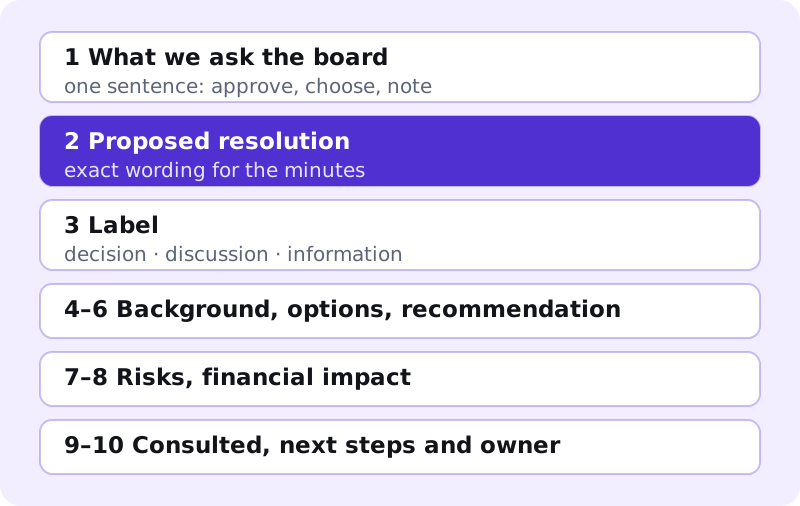
The cover sheet sits in front of every paper and fits on one page. A director who reads only the cover sheets should know what each item is about and what the board is asked to do.
- What we ask the board, in one sentence starting with a verb: approve, choose, note.
- Proposed resolution, in the exact wording that will go into the minutes.
- Label: decision, discussion or information.
- Background: why now.
- Options considered, with the main argument for and against each.
- Recommendation and why.
- Main risks and how they are handled.
- Financial impact: one-off, recurring, within budget or not.
- Who was consulted: CFO, legal, a committee.
- If approved: next steps, owner, date.
How should the paper itself be structured?
The paper behind the cover sheet follows the same order and adds the detail. Three rules keep papers readable:
- A page limit per paper, agreed with the chair. Detail that some directors need goes into a numbered appendix, not into the body.
- Final versions only: date and version on page 1, no tracked changes, no comments, no hidden sheets.
- Numbers with a source, and the same numbers as in the financial report of the same board book.
Late or replaced papers are where board books go wrong. Our posts on one current board book and on the risks of sharing working versions too early cover both cases.
What does a filled-in cover sheet look like?
Paper 7.1 of the fictional Muster AG on one page. All names and amounts are invented.
| Field | Entry |
|---|---|
| We ask the board to | Approve the 2027 budget. |
| Proposed resolution | "The Board of Directors approves the 2027 budget as set out in paper 7.1, with total expenditure of CHF 4,200,000." |
| Label | Decision |
| Background | The budget is the basis for the credit review in January. |
| Options | A: budget as proposed. B: budget without the new sales position, which saves CHF 180,000 and delays the sales plan. |
| Recommendation | Option A, because the sales plan carries a third of next year's growth target. |
| Risks | Higher licence costs; mitigated by a price cap in the supplier contract. |
| Financial impact | Recurring, within the three-year plan. |
| Consulted | CFO, audit committee (meeting of 20 October). |
| If approved | CFO issues the budget to the departments by 15 November. |
A director who reads only this page knows what is asked, can argue with the recommendation and can find the detail. The post on the board paper cover sheet goes through each field in depth.
How is the paper behind the cover sheet built?
| Section | Content | Check |
|---|---|---|
| 1. Purpose | The ask, in one sentence, repeated from the cover sheet | Same wording as the cover sheet |
| 2. Background | What happened, why now, what was decided before | Refers to earlier minutes by date |
| 3. Analysis | Facts, figures, options with arguments for and against | Numbers match the financial report |
| 4. Recommendation | One option and the reason | Does not contradict the analysis |
| 5. Risks and controls | Main risks and how each is handled | Owner named for each |
| 6. Proposed resolution | Exact wording for the minutes | Identical to the cover sheet |
| Appendix A, B, … | Reference material, numbered and listed in the index | Marked as appendix, not part of the reading load |
Information papers are shorter: purpose, the facts and what changed since the last report. A discussion paper replaces the proposed resolution with the questions the board should answer, so that the discussion has a target.
What is a workable timetable to release?
The timetable below is an example. Your organisational regulations may set periods for sending the board book; use them first and fill the rest to match.
| When (before the meeting) | Who | What |
|---|---|---|
| About three weeks | Board secretary | Call for items; chair confirms the agenda draft |
| About two weeks | Paper authors | Papers and cover sheets are due |
| Following days | Board secretary, chair | Check each paper, the board book and the numbering; resolve open points with authors |
| About one week | Board secretary | Release one version to all members; announce the questions deadline |
| Between release and meeting | Board secretary | Collect questions, forward answers to all; send changes as numbered addenda |
Late papers are a policy question, not a case-by-case argument. Our post on a late board papers policy gives you wording the board can adopt, and how to read a board book shows the directors' side.
How should files be named and numbered?
Name every file so that it sorts in agenda order and tells the reader its version. A pattern that works: item number, short title, version, date, for example 07-1_Budget-2027_v2_2026-11-03.pdf. The same number appears on the cover sheet, in the index and in the minutes. Appendices keep the number of their paper plus a letter: 07-1_A_Staffing-plan.pdf.
Confidential material needs its own rule. If a paper concerns a member's conflict of interest, the board can decide, as one of the measures under Art. 717a CO, to release it only to the members without the conflict; note in the index that it is a restricted paper.
Which mistakes weaken a board book?
- A board book that begins with the agenda but has no index with page counts. The reader cannot judge the load.
- A decision paper whose last page is a long appendix and no resolution.
- Replacing a paper without telling anyone. The old file lives on in mailboxes.
- Numbering that changes between agenda, board book and minutes.
- Papers that restate the whole history of a topic. Link to earlier papers by date and say what has changed.
- A board book sent in several parts. If one part is late, mark it as an addendum and update the index.
How do you check the board book before release?
Between the paper deadline and the release, the board office runs three checks: each paper (cover sheet complete, label set, resolution wording present), the board book as a whole (every item has its paper or is marked oral, numbering follows the agenda, index complete) and the release itself (one version for everyone, sent through the agreed channel, access restricted where a member has a conflict). After release, changes go out as a numbered addendum to all members, never as a silent replacement.
Where does a board portal take over?
In Konsaro, papers are attached to their agenda item as PDF files, published board books keep version snapshots, a paper can be replaced with a new version, and access can be restricted per paper or agenda item. See board materials and the page for the corporate secretary.
Frequently asked questions
How long should a board book be?
As short as the agenda allows. There is no standard number of pages. Agree a page limit per paper with the chair and count the total before release; that total is the reading load.
What is a board paper cover sheet?
A one-page summary in front of each paper: what the board is asked to do, the proposed resolution, the options, the recommendation, risks, cost and next steps.
When should the board book be sent?
Your organisational regulations may set a period. About a week before the meeting is common, so directors have time to read and send questions.
Should the minutes of the last meeting be in the board book?
Yes, if the board approves them at the meeting. Add the action log with its current status so directors can see what happened since.
What if a paper arrives after the deadline?
The chair decides: defer it, take it for information only, or accept it as an exception. It then goes out as a marked addendum to all members.
Is a board book the same as a board pack?
Yes. Both mean the collection of agenda, papers and reports for one meeting. "Board pack" is the usual term in the UK; "board book" is common elsewhere and for the bound or portal version. See what a board book is.
Should the board book include a draft of the minutes of the current meeting?
No. The board book holds the minutes of the last meeting for approval. The minutes of the current meeting are written afterwards.
Is a printed board book still acceptable?
Yes, if it is complete and current. The format matters less than version control and a single release. See printed board books are not the problem.
Sources
- Swiss Code of Obligations (SR 220), Art. 716a para. 2: proper reporting to board members (checked 29 October 2026)
- Swiss Code of Obligations (SR 220), Art. 715a: directors' right to information (checked 29 October 2026)
- Swiss Code of Obligations (SR 220), Art. 717a: conflicts of interest (checked 29 October 2026)