
Swiss data protection (revDSG) and board papers
—12 min read
The revised Swiss Federal Act on Data Protection (FADP, often called revDSG or nDSG, in force since 1 September 2023) applies to board materials as soon as they contain personal data, and almost every board book does. The company must keep that data secure (Art. 8 FADP), bind every provider that stores it (Art. 9), safeguard transfers abroad (Art. 16) and report high-risk breaches to the FDPIC (Art. 24). Making sure this is organised is generally treated as part of the board's non-transferable duties (Art. 716a CO).
Which personal data sits in a board book?
More than most boards assume. Personal data is any information relating to an identified or identifiable natural person (Art. 5 let. a FADP). A proposal on the salary round, a report on an employment dispute, the succession plan for the executive team or a director's disclosure of other mandates all contain personal data. Minutes add more: who said what, who abstained, who left the room for a conflicted item.
Some of it is sensitive. The FADP lists, among others, data on health, data on administrative and criminal proceedings or sanctions, and data on social assistance measures (Art. 5 let. c FADP). An agenda item on an executive's long sick leave or on a criminal complaint against an employee falls into this group. Sensitive data raises the bar: where consent is needed it must be explicit (Art. 6 para. 7), and large-scale processing of it can trigger a data protection impact assessment (Art. 22).
| Paper | Personal data | Sensitive under Art. 5 let. c? |
|---|---|---|
| HR and pay proposals | Names, roles, salaries, appraisals | Sometimes (e.g. health) |
| Succession planning | Candidates, assessments | Rarely |
| Legal and compliance cases | People involved, allegations, proceedings | Often (proceedings and sanctions) |
| Whistleblowing reports | Reporter, accused person, witnesses | Often |
| Conflicts of interest | Mandates, holdings, relationships | Rarely |
| Customer and supplier reports | Contact persons, claims | Rarely |
| Minutes | Attendance, statements, votes | Depends on the items discussed |
Is data protection the board's job or management's?
Both, at different levels. The board's non-transferable duties include the ultimate management of the company, issuing the necessary instructions and determining the organisation (Art. 716a para. 1 CO). The board does not have to run data protection itself, but it has to decide who does, approve the framework and hear about the risks. Daily execution can be delegated to management through the organisational regulations (Art. 716b CO).
Delegation does not end responsibility. Whoever lawfully delegates a task to another body is liable for the damage it causes unless they prove they used appropriate care in choosing, instructing and supervising it (Art. 754 para. 2 CO). For data protection, that means a named owner, written instructions and a regular report to the board. The FADP also allows private companies to appoint a data protection adviser (Art. 10), but does not require one.
| Role | Typical responsibility |
|---|---|
| Board of directors | Assigns responsibility, approves policy, receives an annual report, decides on high-risk issues |
| Chair | Puts data protection on the agenda, makes sure incidents reach the board |
| Executive management | Runs the data protection programme, selects and contracts providers |
| Board office (VR-Sekretariat) | Compiles board books with only the data needed, manages access, deletes copies, reports lost devices |
| Data protection adviser (optional) | Advises, checks the record of processing, assesses breaches |
| Each director | Keeps papers and devices secure, reports losses at once |
Write this split into the organisational regulations or a short board policy. Our overview of the board's non-transferable duties shows where data protection fits among the other Art. 716a duties.
What does the FADP require for board papers?
Six duties apply directly to the board book and the minutes. The first four concern how the data is handled; the last two concern the people it is about.
Data security
The company and its processors must ensure data security appropriate to the risk through technical and organisational measures (Art. 8 FADP). The Data Protection Ordinance sets the goals: data must be accessible only to authorised people, available when needed, protected against unauthorised change and processed traceably (Art. 2 DPO). For board papers, that translates into access per agenda item, two-factor sign-in, encryption, and a record of who opened or downloaded what.
Purpose and deletion
Personal data may only be collected for a specific purpose recognisable to the person concerned, and destroyed or anonymised once it is no longer needed for that purpose (Art. 6 paras. 3 and 4 FADP). Minutes are kept because company law requires them; the supporting HR file attached to an item usually is not. Set a retention rule for each type of paper, and make sure copies on directors' devices are deleted too. Our post on retention and deletion of board records goes through the periods.
Processors
A board portal, a cloud drive or an email service that stores board papers is a processor. The company may only hand over processing if the provider processes the data as the company itself may, no secrecy obligation forbids it, and the company has satisfied itself that the provider can guarantee data security; the provider may only bring in third parties with prior approval (Art. 9 FADP). Wilfully handing data to a processor without meeting these conditions is punishable on complaint (Art. 61 let. b FADP). What the contract should contain is covered in our post on the data processing agreement for board software.
Disclosure abroad
Data may go abroad if the Federal Council has found the destination's protection adequate (Art. 16 para. 1 FADP). The list is Annex 1 of the Data Protection Ordinance: it includes Germany and the other EU and EEA states, the United Kingdom and, since 15 September 2024, the United States for organisations certified under the Swiss-US Data Privacy Framework. Other destinations need safeguards such as standard data protection clauses (Art. 16 para. 2). Ask every provider where data is stored and where it is processed; these are not always the same place.
Record of processing
Controllers keep a record of their processing activities (Art. 12 FADP). Companies with fewer than 250 employees on 1 January are exempt unless they process sensitive data on a large scale or carry out high-risk profiling (Art. 24 DPO). Even where the exemption applies, a one-page entry for board work is a cheap way to show the board has thought about it.
Information and access
People must be told when their data is collected (Art. 19 FADP), and anyone can ask whether data about them is processed and receive it (Art. 25). That right can reach minutes that discuss an employee by name. Access can be restricted where overriding interests of third parties require it, or for overriding interests of a private company that does not disclose the data to third parties (Art. 26). Minutes that record decisions and reasons rather than personal remarks are easier to release.
What must happen after a data breach?
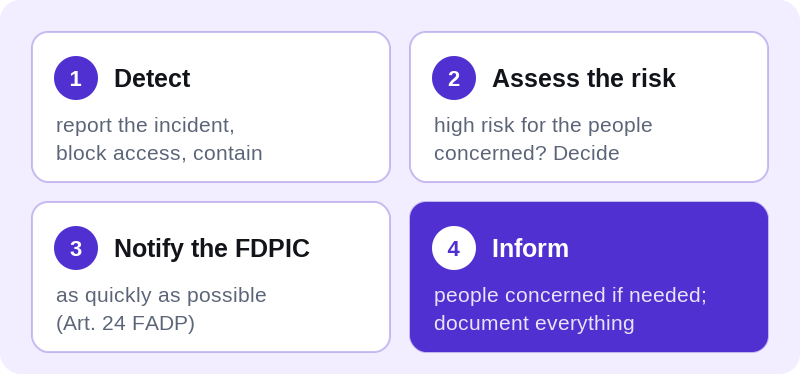
If a breach of data security is likely to lead to a high risk for the people concerned, the company must notify the FDPIC as quickly as possible (Art. 24 para. 1 FADP). A processor must tell the company about any breach as quickly as possible (Art. 24 para. 3). The people affected must be informed where their protection requires it or the FDPIC asks for it (Art. 24 para. 4). The FDPIC runs a reporting portal for notifications and publishes a guide on assessing the risk.
The notification contains at least the nature of the breach, its consequences and the measures taken (Art. 24 para. 2); the ordinance adds, where possible, the time and duration, the categories and approximate number of data and people affected, and a contact person (Art. 15 para. 1 DPO). Every breach, reported or not, must be documented, and the documentation kept for at least two years from notification (Art. 15 para. 4 DPO).
Worked example: the lost tablet at Muster AG (invented)
Muster AG is a fictional company used for illustration. On a Tuesday evening, a director leaves a tablet on a train. It holds a downloaded board book with a proposal to dismiss the head of sales and a medical certificate attached to it. The director calls the board secretary the same evening.
- Contain (board secretary, same evening): disable the director's portal account and revoke the device session; ask the provider whether the file was downloaded or only viewed online.
- Assess (data protection owner, next morning): health data and a dismissal are sensitive; the device had a PIN but the file was stored outside the portal app. Result: high risk likely.
- Decide (CEO with the chair): notify the FDPIC through its portal; inform the head of sales personally, because the data concerns them directly.
- Document (data protection owner): facts, assessment, decision and measures in the breach log, kept for at least two years.
- Prevent (board, next meeting): decide that sensitive papers are view-only and cannot be downloaded to devices.
Had the paper been viewable only online, with the session revoked at once, the assessment could have come out differently. The protective measures in place are part of the risk analysis.
Who is personally liable under the FADP?
Unlike the GDPR, the FADP generally fines individuals, not companies. Private persons who wilfully disclose data abroad in breach of Art. 16 and without an exception under Art. 17, hand processing to a processor without meeting the conditions of Art. 9, or disregard the minimum data security requirements set by the Federal Council face a fine of up to CHF 250,000, on complaint (Art. 61 FADP). Where identifying the responsible person would be disproportionate and the fine would not exceed CHF 50,000, the company itself can be ordered to pay (Art. 64 FADP).
Who the responsible person is depends on the organisation: often the manager who made the decision, not the board. Directors' civil liability under company law (Art. 754 CO) applies alongside. Both depend on the facts, so have a lawyer assess any specific case.
What changes for a GmbH, an association, a foundation or a group?
- GmbH: the managing directors have the same non-transferable duties of ultimate management and organisation (Art. 810 para. 2 CO). Everything above applies to them.
- Association (Verein) or foundation (Stiftung): the FADP applies to all private persons that process personal data, whatever their size or legal form. Member lists, donor files and case reports in a foundation board's papers are personal data like any other.
- Group subsidiary: each company is its own controller. A group policy helps, but the subsidiary's board still has to make sure it applies locally. If the subsidiary sits in the EU, the GDPR applies to it.
For EU subsidiaries and German boards, our post on the GDPR and board materials covers the EU rules.
Which questions belong on the next board agenda?
This checklist works as an information item in an ordinary board meeting.
- Who is responsible for data protection in the company, and when did the board last receive a report?
- Through which channel do members receive the papers, and where do copies remain afterwards?
- Which providers store or process board papers, and is there a data processing agreement with each of them?
- In which countries is the data stored and processed, and on what basis under Art. 16 FADP?
- Who decides on notifying the FDPIC, and how does that person learn about a lost device the same day?
- How long are papers with personal data kept, and who deletes them, including on directors' devices?
- Are sensitive items such as HR cases shared only with the members who need them?
A possible minute entry: “The board took note of the data protection report. It confirmed the CFO as responsible for data protection, instructed management to conclude a data processing agreement with every provider storing board papers by the next meeting, and decided that papers containing sensitive personal data are made available view-only.”
A board portal answers some of these questions through its settings. In Konsaro, board data is stored in Zürich and the application servers run in the EU; data is encrypted at rest (AES-256) and in transit (TLS); access can be restricted per paper and per agenda item; papers can be set to view only; and the audit log records downloads. The sub-processors page lists every provider and the data processing agreement is public.
Frequently asked questions
Does the FADP apply to small companies?
Yes. It applies to all private persons and companies that process personal data. The relief for small companies concerns the record of processing: companies with fewer than 250 employees are exempt unless they process sensitive data on a large scale or carry out high-risk profiling (Art. 24 DPO).
Are directors personally liable for data protection breaches?
The criminal provisions target natural persons who act wilfully, for example by disregarding the minimum data security requirements (Art. 61 FADP). Who is responsible depends on the organisation; often it is the person who took the decision, not the board. Civil liability under Art. 754 CO applies alongside, so have a specialist assess a specific case.
May board papers be stored in the EU?
Yes. The EU and EEA states are on the list of countries with adequate protection in Annex 1 of the Data Protection Ordinance. Still check whether further providers in other countries are involved, for example for email, SMS or AI features.
Do board members need a privacy notice?
If the company processes personal data about its directors, the duty to inform under Art. 19 FADP applies to them as well. A reference to the company's privacy notice with a short section on board work and the board portal usually covers it.
Is a data protection impact assessment needed for a board portal?
Only where the processing may cause a high risk, for example with large-scale processing of sensitive data (Art. 22 FADP). For most boards a documented risk assessment is enough. Record the decision and the reasons; our post on impact assessments for board software has an outline.
Can an employee demand the board minutes that mention them?
They can ask for the personal data about them, which can include passages in minutes (Art. 25 FADP). The company may restrict the answer where overriding interests of third parties require it, or its own overriding interests if it does not pass the data on to third parties (Art. 26), and must say why.
Sources
- Federal Act on Data Protection (FADP, SR 235.1), Art. 5, 6, 8, 9, 10, 12, 16, 17, 19, 22, 24, 25, 26, 61, 64 (checked 29 October 2026)
- Data Protection Ordinance (DPO, SR 235.11), Art. 2, 15, 24 and Annex 1 (Annex 1 as amended with effect from 15 September 2024) (checked 29 October 2026)
- Swiss Code of Obligations (SR 220), Art. 716a, 716b, 754, 810 (checked 29 October 2026)
- FDPIC: Guide on notifying data security breaches under Art. 24 FADP (version 1.2, April 2025, German) (checked 28 October 2026)