
Swiss hosting vs EU hosting for board data: what changes
—11 min read
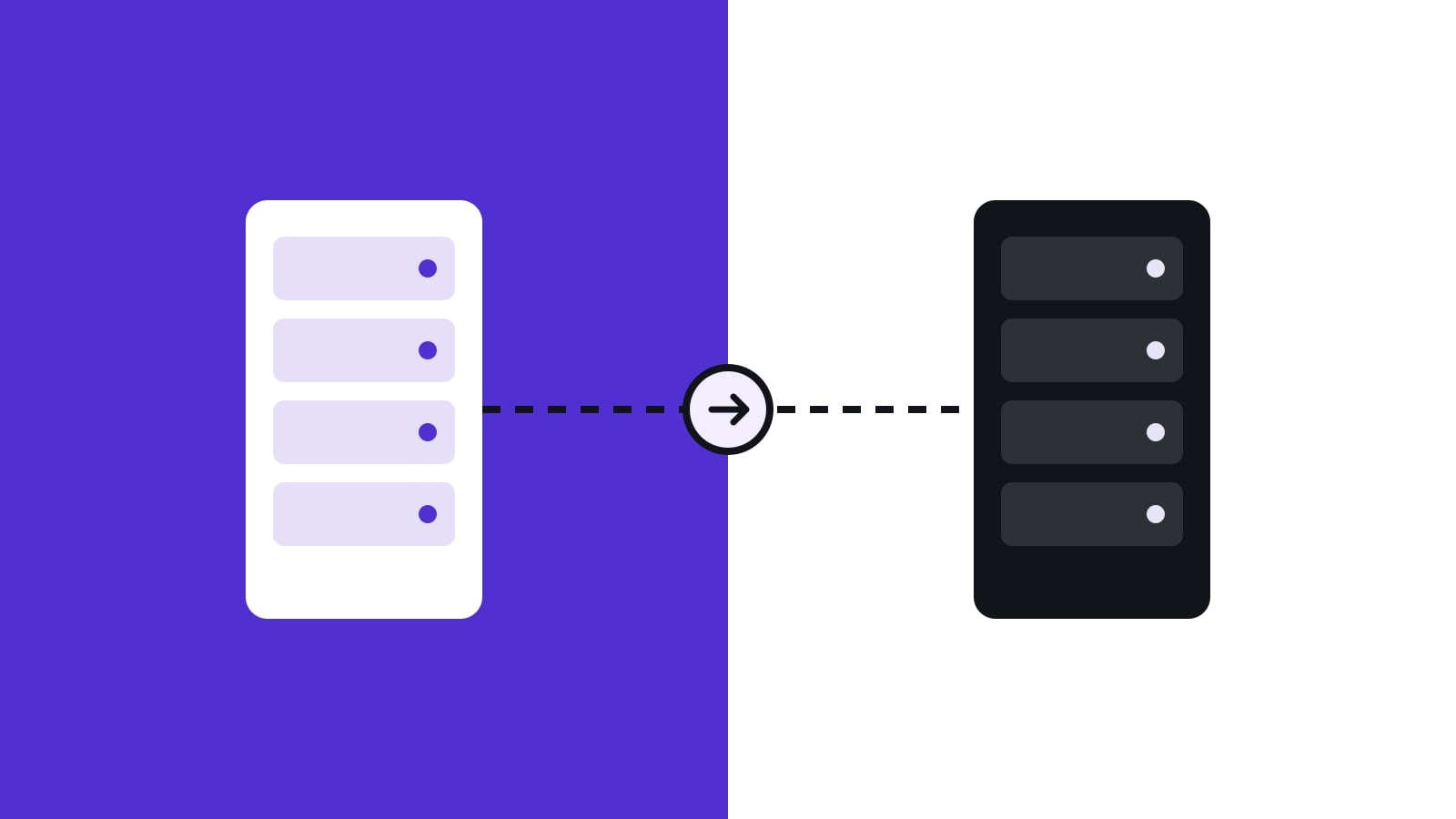
For a Swiss board, hosting board data in Switzerland or in the EU are both lawful: the EU states are on the Federal Council's list of countries with adequate protection, and the EU recognises Switzerland in return. What really differs is hidden behind the word “hosting”: where the data is stored, where it is processed, and which countries' laws reach the provider and its sub-processors. A good decision answers all three, not just the first.
Is EU hosting allowed for Swiss board data?
Yes. Personal data may be disclosed abroad if the Federal Council has found that the destination provides adequate protection (Art. 16 para. 1 FADP). Annex 1 of the Data Protection Ordinance lists those countries: Germany and the other EU and EEA states are on it, as is the United Kingdom. No extra contract clauses are needed for that reason alone.
Two duties remain. When personal data goes abroad, the company must tell the people concerned which country it goes to (Art. 19 para. 4 FADP), and its record of processing names the countries (Art. 12 para. 2 let. g). In practice that means one line in the privacy notice and the record: “Board materials are stored in Switzerland and processed in Germany.”
Is Swiss hosting allowed for German and other EU boards?
Yes. A transfer to a country with an EU adequacy decision needs no specific authorisation (Art. 45(1) GDPR). Switzerland has had such a decision since 2000, and the European Commission confirmed on 15 January 2024 that the revised Swiss law still provides adequate protection. For a German supervisory board, a Swiss data centre raises no more transfer questions than one in Frankfurt. Our comparison of board portals with German data centres covers vendors that host in Germany.
What does “hosted in Switzerland” actually tell you?
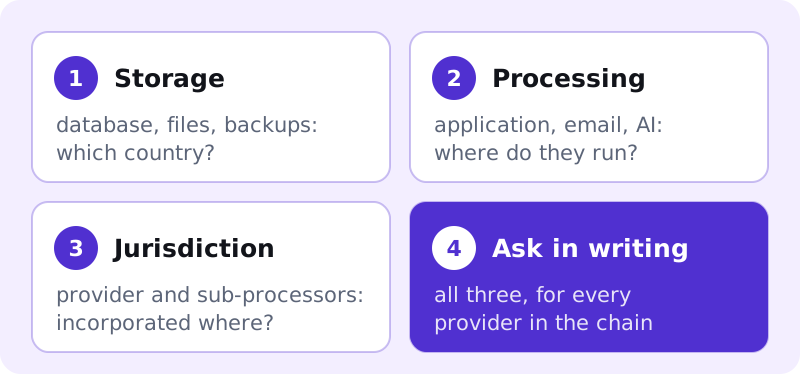
Usually only where the data rests: the database and the file storage. It does not tell you where the application code runs that opens, renders and changes the papers, where backups go, where support staff log in from, or which companies are involved. A board portal can store papers in Zürich and still process them in Frankfurt, send notification emails through a US service and route AI requests through yet another provider.
| Question | What it means | What to ask |
|---|---|---|
| Storage location | Where the database, files and backups rest | Which data centre and country, including backups |
| Processing location | Where servers handle the data while it is in use | Where the application and any AI, email or SMS services run |
| Jurisdiction | Which countries' laws can reach the provider | Where the provider and each sub-processor are incorporated, and who owns them |
What does Swiss storage change, and what doesn't it?
Swiss storage changes less in data protection law than most people expect, and more in contracts and expectations. The table compares the two options for a Swiss company's board.
| Topic | Data stored in Switzerland | Data stored in the EU |
|---|---|---|
| Transfer rules under the FADP | No disclosure abroad | Allowed: EU states are on Annex 1 DPO |
| Privacy notice and record | No country to name | Name the country (Art. 19 para. 4, Art. 12 FADP) |
| Transfers from EU subsidiaries | Covered by the EU adequacy decision | No transfer within the EU |
| Sector rules (e.g. FINMA outsourcing) | Usually the easier case | Check the specific rule and contract |
| Contracts with clients or lenders | Meets “data in Switzerland” clauses | May breach such clauses |
| Order from a foreign authority to the provider | Depends on the provider's jurisdiction | Depends on the provider's jurisdiction |
| Theft from the data centre | Depends on encryption and controls | Depends on encryption and controls |
Two rows deserve a closer look. FINMA-supervised banks, insurers and certain financial institutions have their own outsourcing circular (FINMA Circular 2018/3), which goes beyond general data protection law; our FINMA checklist for board portals covers it. And a statutory or contractual secrecy duty can forbid handing data to a processor at all (Art. 9 para. 1 let. b FADP), so check client contracts before moving board papers that contain client data.
Does Swiss storage protect against foreign authorities?
Only partly. Storage location decides which data centre an order would have to reach physically. Jurisdiction decides which authorities can order a provider to hand over data, wherever it is stored. Under US law, a provider of remote computing services that receives a valid US warrant, subpoena or court order must comply for data in its possession, custody or control, regardless of whether the data is located inside or outside the United States (18 U.S.C. § 2713). A US provider with a Zürich data centre can therefore still be reached. Our post on the US CLOUD Act and Swiss board data explains how far that goes.
Encryption changes the picture only if the provider cannot decrypt. If the customer holds the keys, a provider cannot hand over readable data. If the provider holds them, which is usual for web applications that display documents, encryption protects against theft from the data centre but not against a lawful order to the provider. Our explainer on encryption at rest and in transit covers the difference in plain language.
Which set-up fits which board?
Start from your own constraints, not from the vendor's marketing. This table is a starting point; the right answer depends on your contracts and regulator.
| Board | Usual requirement | What to check first |
|---|---|---|
| Swiss SME, no special regulation | Switzerland or EU both fine | Sub-processors, encryption, contract |
| Swiss bank, insurer or other FINMA-supervised institution | Sector outsourcing rules apply | FINMA Circular 2018/3, audit rights, the outsourcing contract |
| Swiss group with EU subsidiaries | One portal for all boards | Adequacy works both ways; check each sub-processor |
| German AG (Vorstand and Aufsichtsrat) | EU or Switzerland both fine under the GDPR | Art. 28 contract, works council or group policy |
| Foundation or association | Often no sector rule | Donor and member data, board members' private devices |
| Company with clients that require Swiss data | Swiss storage in the contract | Wording of the client contract, backups and support access |
Which questions should you ask any board portal vendor?
These eight questions cover what a hosting page usually leaves out. Ask for written answers, so they can be compared and attached to the board's decision.
| Question | A good answer |
|---|---|
| Where are the database, file storage and backups located? | Named data centre region and country for each, backups included |
| Where do the application servers run? | A named country, even if different from storage |
| Which sub-processors handle board data, and where is each located and incorporated? | A public list with purpose, data, location and company |
| Do email, SMS or AI features send board content to further providers, and can they be switched off? | Which content leaves, to whom, and an admin switch |
| Who holds the encryption keys? | A clear statement, without pretending provider-held keys are customer-held |
| How are we told about sub-processor changes, and can we object? | Advance notice and a right to object in the contract |
| Where are support staff, and can they see board content? | Location, access only on request, logged |
| How do we get all our data out at the end? | Export formats and deletion confirmation in the contract |
Our guide to reading a sub-processor list explains how to check the answers to questions 3 and 6.
Worked example: Muster AG compares two portals (invented)
Muster AG is a fictional Swiss industrial company with a German subsidiary. It shortlists two invented board portals. Portal A advertises “100 % Swiss hosting”: database and files in Zürich, but notification emails go through a US email service and its AI summary feature uses a US model provider. Portal B stores data in Frankfurt with an EU-owned host, sends email through an EU provider and has no AI feature.
On storage alone, Portal A looks better. On jurisdiction, Portal B has fewer providers within reach of foreign law. The board office asks both vendors the eight questions above and finds that Portal A lets admins switch off AI and limit email notifications to a link without content. With those switches set, the remaining difference is the US email service, which only sees names, email addresses and meeting titles.
The board decides for Portal A with AI switched off and content-free notifications, because a key lender's contract requires board data to be stored in Switzerland. Possible minute entry: “The board approves Portal A. Board data is stored in Switzerland. AI features remain disabled; email notifications contain no meeting content. The board office reviews the vendor's sub-processor list every year and reports changes.”
How should the board office prepare the decision?
A hosting decision does not need a long paper, but it needs a complete one. This sequence fits into an ordinary board meeting:
- Collect the constraints (board office with legal): sector rules, clauses in client and loan contracts, group policy, directors' expectations.
- Classify the data (management): which papers are sensitive, such as HR cases, acquisitions or litigation, and which are routine?
- Send the questions to the vendors (board office): the eight questions above, in writing, with a deadline.
- Compare the answers (IT or information security): storage location, processing location and jurisdiction per vendor and per sub-processor in one table.
- Propose (management): a recommendation with the remaining risks and the settings that reduce them.
- Decide and record (board): the decision, the reasons and a yearly review in the minutes.
Done this way, the board can later show an auditor, a regulator or a lender why the chosen set-up was adequate.
Which mistakes do boards make with hosting?
- Treating “Swiss hosting” as a complete answer without asking where processing and backups happen.
- Checking the vendor but not its sub-processors for email, SMS, monitoring or AI.
- Assuming encryption stops a lawful order to a provider that holds the keys.
- Forgetting the copies: downloads on directors' laptops and attachments in private inboxes sit outside any hosting promise.
- Not recording the decision, so nobody can later explain why the set-up was acceptable.
- Never checking again after the vendor changes providers.
How does Konsaro answer these questions?
Konsaro is a Swiss product, so we use our own set-up as a transparent example. Board data is stored in Zürich, Switzerland. The application servers run in the EU. Data is encrypted at rest (AES-256) and in transit (TLS). The AI copilots use AI models in the EU with zero data retention, and organisation admins can switch AI off for the whole organisation. Every provider, with its purpose, data and location, is on the sub-processors page, so you can apply the questions above to us as to any vendor. Our post on where Swiss board portals store data compares other vendors' set-ups.
Frequently asked questions
Is Swiss hosting required by Swiss law?
Not in general. The FADP allows disclosure to countries with adequate protection, including the EU states. Sector rules, secrecy duties, client contracts or the company's own policy can still require Swiss storage.
Is EU hosting enough for a German or Austrian board?
Under the GDPR, storage within the EU raises no transfer question, and Switzerland has an EU adequacy decision too. The choice between the two then depends on the provider, its sub-processors and the contract, not on the GDPR itself.
Does a Swiss provider guarantee that data stays in Switzerland?
Not automatically. Ask where backups, application servers and sub-processors are located. A Swiss company can still use providers abroad, and should say so.
Does a Swiss data centre run by a US cloud provider count as Swiss hosting?
For storage location, yes. For jurisdiction, no: a US provider can be ordered under US law to disclose data in its control regardless of where it is stored (18 U.S.C. § 2713). Whether that matters depends on your data and your risk appetite.
Do we have to tell directors where their data is stored?
If personal data about them goes abroad, yes: the duty to inform includes the destination country (Art. 19 para. 4 FADP). A line in the privacy notice or the board portal's terms is usually enough.
Does the location of backups matter?
Yes. A backup is a full copy of the data and falls under the same rules as the live data. If a contract requires storage in Switzerland, it will usually cover backups too, so ask about them explicitly and have the location written into the contract.
Should board papers be stored on our own servers instead?
Self-hosting gives full control of location, but also full responsibility for security, updates, backups and availability on meeting day. For most boards, a provider with clear answers to the questions above is the safer choice.
Sources
- Federal Act on Data Protection (FADP, SR 235.1), Art. 9, 12, 16, 19 (checked 29 October 2026)
- Data Protection Ordinance (DPO, SR 235.11), Annex 1: states with adequate protection (as amended with effect from 15 September 2024) (checked 29 October 2026)
- General Data Protection Regulation (EU) 2016/679, Art. 45, EUR-Lex (checked 28 October 2026)
- FDPIC: EU adequacy decision regarding Switzerland (15 January 2024) (checked 28 October 2026)
- FINMA: circulars, including Circular 2018/3 “Outsourcing” (checked 28 October 2026)
- 18 U.S.C. § 2713: required preservation and disclosure of communications and records (checked 29 October 2026)