
From transcript to signed board minutes in 48 hours
—12 min read
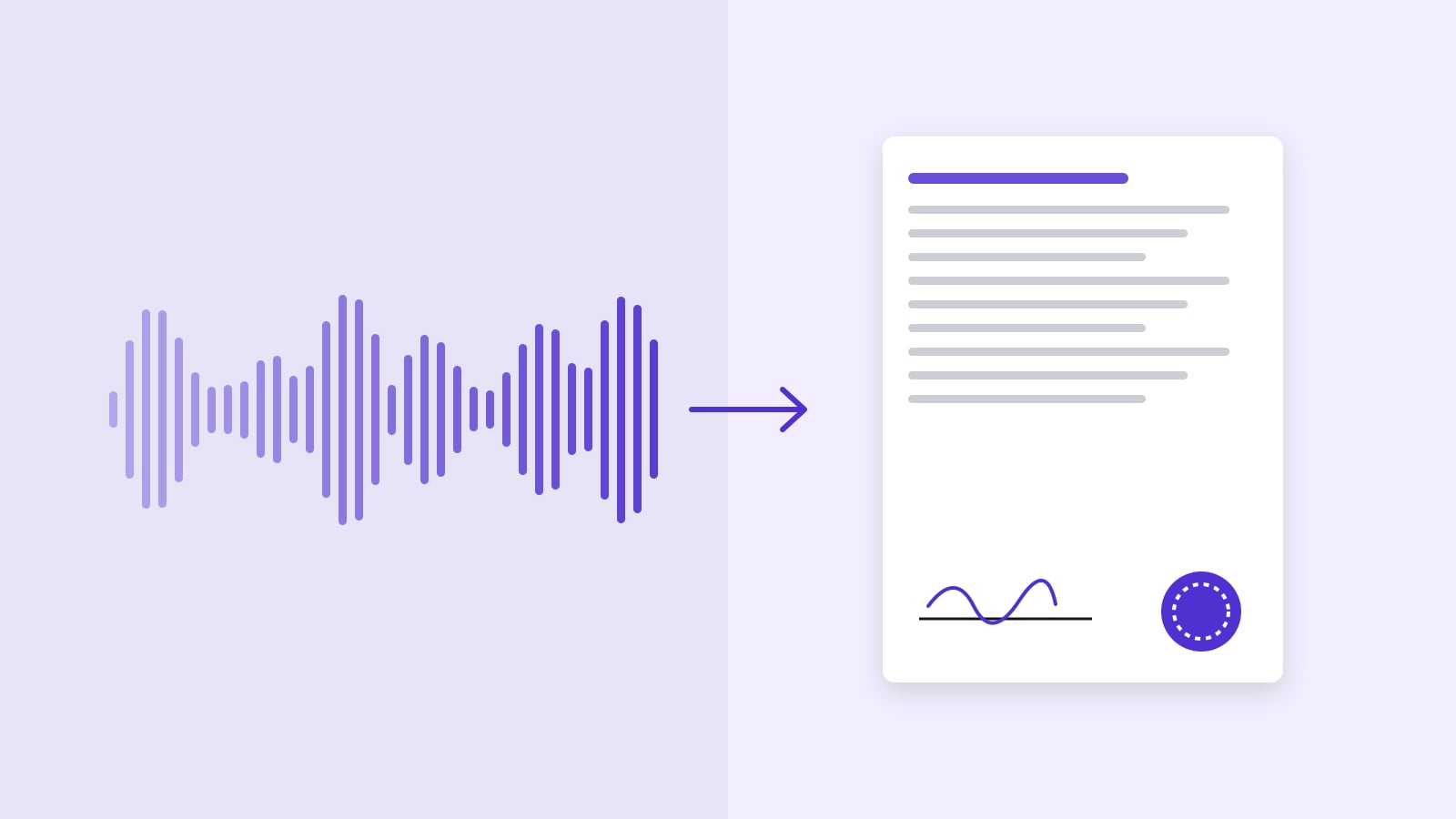
Signed minutes within 48 hours are realistic if the transcript is only a source, not the draft. Export it right after the meeting, write the minutes from the agenda and the resolutions, check every decision against the transcript, send the draft to the chair the next morning, and collect both signatures by day two. Art. 713 para. 3 CO requires the chair and the secretary to sign.
What do you need before the meeting starts?
The 48 hours start before the meeting. Most delays come from waiting for things that could have been prepared in advance: a minutes template, the exact wording of each proposal, and a slot in the chair's calendar for the review.
- A minutes template per board, with the agenda items already filled in from the published agenda.
- The proposed resolution text for every decision item, taken from the papers.
- Agreement on who records the meeting and who starts transcription. In Microsoft Teams, the organiser and people from the same organisation can start it; in Zoom, the audio transcript is produced for cloud recordings.
- A 30-minute review slot in the chair's calendar on the morning after the meeting.
- A short notice at the start of the meeting that it is being transcribed, and why.
How does the 48-hour workflow run?
Here is a worked example for a board meeting that ends at 17:00 on a Tuesday.
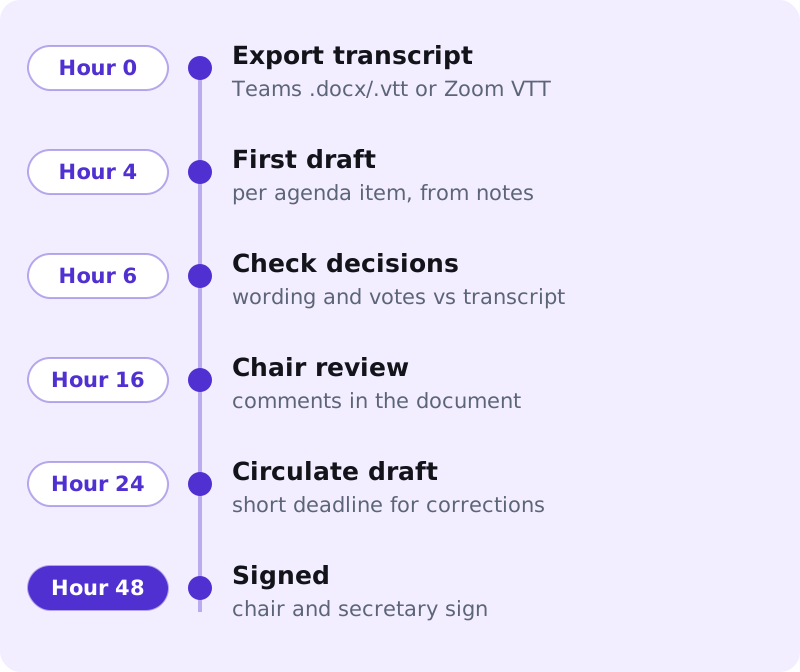
- Hour 0 (Tuesday 17:30): export the transcript. In Teams, organisers and co-organisers can download it as a .docx or .vtt file from the meeting recap. In Zoom, the audio transcript of a cloud recording appears as a separate VTT file.
- Hours 1 to 4 (Tuesday evening or Wednesday 08:00): write the first draft per agenda item: what was presented, the main points of discussion, the decision with its exact wording, the vote and the action items with owner and due date. Write from your own notes and the agenda; open the transcript only to fill gaps.
- Hours 4 to 6: check every decision and vote against the transcript. Search for the item, read the passage where the chair stated the result, and correct the wording if it differs from the paper.
- Hour 16 (Wednesday 09:00): the chair reviews the draft in the agreed slot. Ask for comments in the document, not in a separate email thread.
- Hour 24 (Wednesday 17:00): send the corrected draft to all members with a short deadline for factual corrections, for example Friday noon, if your board circulates drafts before signing.
- Hour 48 (Thursday 17:00): the chair and the secretary sign. Many boards sign on paper or with a qualified electronic signature combined with a qualified time stamp, which Art. 14 para. 2bis CO treats as equal to a handwritten signature.
If the board approves minutes formally at the next meeting, the signed version can still be ready in 48 hours. Approval then confirms a document everyone has already read.
What does a transcript passage look like next to the minute entry?
An invented example for Muster AG (fictional). Agenda item 4 is a CHF 400,000 budget increase for a warehouse extension. Here is what the transcript contains, and what the minutes keep.
| Transcript (raw) | Minutes (final) |
|---|---|
| "…so, um, Peter, can you say what the contractor quoted? Four hundred… was it four-twenty? No, four hundred thousand plus VAT. And honestly I never trusted that quote, but fine. Right, let's vote. Who's in favour? Everyone? Maria, you're muted. OK, Maria is in favour. Done." | 4. Warehouse extension. The CFO presented the contractor's offer of CHF 400,000 excl. VAT. The board discussed the fixed-price risk and asked management to confirm the price cap in writing. Resolution: the board approves a budget increase of CHF 400,000 for the warehouse extension (5 in favour, 0 against, 0 abstentions). Action: CFO to provide the written price cap by 15 December. |
| Figure stated twice, corrected in speech | One figure, checked against the offer in the papers |
| Personal opinion about the contractor | Left out; the business concern is recorded as the question put to management |
| "Everyone? Done." | Vote count by name or total, as your rules require, and the exact resolution text |
The minute entry is shorter than the transcript passage and says more: it names the amount, the decision, the vote and the follow-up. For how much detail your board should keep overall, see how detailed board minutes should be.
What should each decision entry contain?
Every decision entry needs the same five elements, so the chair can check it in seconds: the subject, the information the board relied on, the exact resolution wording, the vote, and the follow-up with owner and date. The first two are where drafts written from transcripts are usually weakest, because the transcript buries them in conversation.
- Subject: one line that names the item and the paper it refers to.
- Basis: the papers and the key facts the board relied on, so a later reader sees that the decision was informed.
- Resolution: the wording as proposed in the paper, changed only where the board changed it during the meeting.
- Vote: unanimous, or the count with named dissent or abstention. A board that records dissent follows a fixed pattern; see dissent in board minutes.
- Follow-up: owner and due date for each action.
Sample wording for the three situations that cause most corrections (invented text for Muster AG):
- Amended proposal: "The board approves the proposal in the version amended during the meeting: the budget is limited to CHF 350,000, and any increase requires a new board resolution."
- Recusal: "Ms Muster declared her interest in the supplier and left the room for this item. She did not take part in the deliberation or the vote."
- Deferral: "The board deferred the decision to the meeting of 12 February. Management is to provide a comparison of two alternative suppliers."
What should never go from the transcript into the minutes?
A transcript records everything, minutes record what the company needs to prove. Copying text across makes minutes longer, harder to read and riskier.
| In the transcript | In the minutes | Why |
|---|---|---|
| Side remarks, jokes, small talk | Nothing | Not part of the deliberation; easily misread later |
| Guesses about people ("I think she will resign") | Nothing, or the factual decision that followed | Personal data and speculation have no place in a company record |
| Names in confidential items (HR, disputes) | Roles instead of names where possible, or a reference to a confidential annex | Data protection asks for no more personal data than the purpose needs (Art. 6 FADP) |
| Long discussion, word for word | The main arguments in two or three sentences | Minutes show that the board deliberated, not every word |
| "OK, then let's do it" | The exact resolution text, the vote and any abstentions | The decision must be clear without the recording |
| Transcription errors in names and numbers | The correct names, amounts and dates from the papers | Transcripts often get figures and proper names wrong |
Which mistakes cost the most time?
| Mistake | What happens | Fix |
|---|---|---|
| Pasting the cleaned transcript as the minutes | The draft is long, nobody wants to review it, and side remarks become part of the record | Write from the agenda; use the transcript only to verify |
| Trusting names and figures in the transcript | Speech recognition mishears surnames, amounts and dates | Take names and figures from the papers and the attendance list |
| Reviewing the draft only at the next meeting | Corrections come weeks later when nobody remembers the debate | Send to the chair the next morning, as in the timeline above |
| Loose resolution wording ("we agreed to proceed") | The decision cannot be executed or proven | Write the wording as a resolution before the meeting and adjust only where the board changed it |
| Keeping several copies of the transcript | A confidential file lingers in inboxes and on laptops | One working copy, deleted when the minutes are signed |
| Nobody owns the signature step | Minutes sit unsigned for weeks | Name the person who collects both signatures, and the date |
Who does what between the meeting and the signature?
| Step | Owner | Output |
|---|---|---|
| Start transcription and announce it | Meeting organiser | Transcript exists; participants informed |
| Export transcript, protect the file | Secretary or board office | One working copy in the board folder |
| Write the draft from agenda and resolutions | Secretary | Draft per agenda item |
| Verify decisions and figures | Secretary | Checked list of resolutions |
| Review | Chair | Comments in the document |
| Circulate for factual corrections (if your board does) | Secretary | Corrections received by the deadline |
| Sign | Chair and secretary | Signed minutes filed; transcript deleted |
What do you do with the transcript afterwards?
Decide this once, in writing, before the first transcribed meeting. The minutes are the company's record; the transcript is a working file. Most boards delete it after the minutes are signed, unless a legal hold or the organisational regulations require keeping it.
Keep in mind where it sits. In Teams, the transcript stays available in the meeting's recap, and in Zoom it sits next to the cloud recording in the list of recorded meetings. If you delete your downloaded copy but not the original in the meeting tool, the transcript still exists. Check both.
What changes in other board types?
The route works for any body that keeps minutes, but the rules around it differ. Check your own documents before you copy it.
- Executive team or committee: the Swiss Code of Obligations does not prescribe their minutes in the same way as the board's. Your organisational regulations may, so follow those and keep the same signature step.
- GmbH: the articles and the organisational regulations set how the managing directors meet and minute. The transcript-as-source approach applies unchanged.
- Foundation or association: the deed, bylaws or regulations set the signatories. Often the chair and the person who took the minutes sign, but check the document, not the habit.
- Several languages: if the board works in German and English, produce the minutes in the language of the deliberation first. Translate afterwards and say which version is authoritative.
Can an AI copilot write the first draft?
Yes, if the board allows it, the tool is covered by the company's contract, and the secretary treats the result as a draft. An AI draft saves typing, not checking: every decision, vote and name still needs the same verification as in step 3.
In Konsaro, the Minutes Copilot works per agenda item. It receives the item's title, type and description, the meeting transcript (pasted text or a .vtt file) and any notes already in the minutes, and it suggests tasks that a person accepts or dismisses. AI requests are processed in the EU with zero data retention, board material is not used for training, and the board office reviews every result. The minutes then have comments and a version history, the draft can be shared with selected people for review, and the final version exports as PDF for signing. More on the minutes and follow-up page and the AI copilots page.
For the bigger picture, our post on minutes as the control point explains why minutes are where errors in the board cycle get caught or locked in, and AI briefings without hallucinations shows how to keep AI output tied to its sources.
Frequently asked questions
Who has to sign board minutes in Switzerland?
The chair and the secretary who took the minutes (Art. 713 para. 3 CO). The other members do not sign, although many boards approve the minutes at the next meeting.
Can a meeting transcript replace the minutes?
No. The law asks for minutes of the deliberations and resolutions, signed by the chair and the secretary. A transcript is a raw record with errors and side remarks; minutes state the decisions clearly.
Do participants have to agree to transcription?
Tell participants at the start that the meeting is transcribed and what the transcript is used for. Whether consent is required depends on the circumstances; agree the board's rule with your legal adviser and write it down.
How long should the transcript be kept?
Only as long as needed to finish the minutes, unless your rules or a legal hold require more. Remember to delete it in the meeting tool as well as any downloaded copies.
Is a scanned signature enough?
Art. 14 CO treats a qualified electronic signature with a qualified time stamp as equal to a handwritten one. A scanned image of a signature is not the same thing; ask your legal adviser what your board's practice should be.
What if the chair wants to change the minutes after reading them?
Changes that correct facts, wording of a resolution or a name are normal. Changes that alter what the board actually decided are not: raise those at the next meeting so the board can decide again. Keep the version history so the earlier draft can be shown.
Can the transcript help if members dispute what was decided?
It can help settle a dispute about what was said, which is why some boards keep it until the minutes are approved. Decide in your rules how long that is and who may open it.
Is an automatic AI summary the same as minutes?
No. A summary is a draft input. Minutes record the decisions and the deliberation in the form the board wants to stand behind, and the secretary and chair sign them.
Sources
- Swiss Code of Obligations (SR 220), Art. 14 and 713 (official German text on fedlex) (checked 29 October 2026)
- Federal Act on Data Protection (FADP, SR 235.1), Art. 6 (checked 29 October 2026)
- Microsoft Support: Start, stop, and download live transcripts in Microsoft Teams meetings (checked 27 October 2026)
- Zoom Support: Using audio transcription for cloud recordings (checked 27 October 2026)