

Board meeting minutes template with example wording
—10 min read

Good board minutes record who attended, what was decided in the exact wording, how the vote went and who does what next, with only a short summary of the discussion. Use one section per agenda item with four fixed lines: discussion, resolution, vote, actions. The template below follows that pattern and adds example wording for the moments that are hard to write, such as dissent and abstentions.
What should board minutes contain?
Every set of minutes needs the same core: the company and body, the date, time and place or video link, who attended and in what capacity, whether the meeting could decide, the agenda items in order, and the signatures your law and rules require. In Switzerland the chair and the secretary sign (Art. 713 para. 3 CO); other jurisdictions have their own rule, so check yours.
| Section | Content | Tip |
|---|---|---|
| Header | Company, body, meeting number, date, start and end, format | Number meetings so actions can reference them |
| Attendance | Present, by video, apologies, guests per item | Note late arrivals and early departures with the time |
| Opening | Quorum, conflicts of interest, agenda approved | "No conflicts declared" is worth writing down |
| Each agenda item | Presented by, discussion, resolution, vote, actions | Same four lines every time |
| Circular resolutions | Resolutions passed in writing since the last meeting | Date, wording and votes |
| Closing | Time closed, next meeting | Short |
| Signatures | Chair and secretary, approval date | Follow your jurisdiction |
How much detail should the minutes have?
Less than most first drafts. Minutes are a record of decisions and of the reasons behind them, not of every remark. Three levels are common, and most boards settle on the middle one.
- Verbatim: everything said. Hard to read, risky to keep, and rarely required. A recording or transcript is not the minutes.
- Resolution minutes with a short discussion summary: the decision word for word, plus three to five lines on the main points, the questions the board asked and the answers it got. This shows the board did its job without quoting anyone.
- Action minutes only: decisions and actions, no discussion. Fine for an executive team, usually too thin for a board that may need to show how it reached a decision.
A useful test: could a director who missed the meeting understand from the minutes what was decided, on which papers, and what concerns were raised? If yes, the detail is right. Our post on why minutes are the control point explains why naming the paper version matters.
How do you word a resolution?
Start with the body and a verb, refer to the paper, and make the sentence stand on its own. If someone reads only the resolution ten years from now, it should still say what the board approved.
| Type | Example wording |
|---|---|
| Approval | "The Board approves the 2027 budget as set out in paper 7.1, version of 3 November 2026." |
| Approval with conditions | "The Board approves the lease subject to legal review of clause 12; the CFO reports back by 15 January." |
| Delegation | "The Board authorises the CEO and the CFO to sign the contract with supplier B within a budget of [amount]." |
| Election or appointment | "The Board appoints [name] as Chief Financial Officer with effect from [date]." |
| Deferral | "The Board defers the decision to its meeting of [date] and asks management for [information]." |
| Noting | "The Board takes note of the risk report (paper 9)." |
How do you record dissent and abstentions?
Record the numbers for every vote, or "unanimous". Record a director's vote against by name when the director asks for it, with the reasons the director gives. That record can matter later: a director who voted against and had it minuted is in a different position from one who stayed silent.
- Dissent: "[Name] voted against and asked for the following reasons to be minuted: […]"
- Abstention: "[Name] abstained." Add reasons only if the director gives them and asks for them to be recorded.
- Recusal: "[Name] declared a conflict of interest on item [no.], left the meeting at [time] and did not take part in the discussion or vote."
- Casting vote: "With [ ] votes for and [ ] against, the chair used the casting vote in favour."
What do finished minutes look like?
The fictional Muster AG, item 6, shown in the four-line format. All names and amounts are invented.
| Line | Entry |
|---|---|
| Item | 6. Lease for the Winterthur site. Presented by the CFO, paper 6, version of 28 October 2026. In attendance for this item: Head of Real Estate (A. Weber). |
| Declarations | S. Brunner declared a conflict of interest: a close relative owns the landlord. The Board decided that S. Brunner would not take part in the discussion or the vote. S. Brunner left the meeting at 15:20 and returned at 15:45. |
| Discussion | The CFO presented two options, a five-year lease and a ten-year lease with a break clause after five years. The Board asked about the rent compared with the current site and about the fit-out costs. The Head of Real Estate answered that a second quote had been obtained. |
| Resolution | The Board approves the ten-year lease with a break clause after five years, as set out in paper 6, and authorises the CEO and the CFO to sign it. |
| Vote | Four in favour, none against, no abstentions (S. Brunner did not take part). Carried. |
| Actions | Legal: final review of clause 12 before signing, by 15 January. CFO: report on the fit-out budget at the March meeting. |
Notice the declarations line: it sits above the discussion because the recusal came first in time, and the times let a reader check that S. Brunner was out of the room for the vote. A short entry like this is enough; the paper holds the detail.
What does the minute-taker do during the meeting?
- Before the meeting: prepare the shell from the agenda numbers, with the attendance list and the resolution wording from the papers.
- At the start: record who is present, who is on video, who sent apologies, and the time the meeting opened.
- Per item: write down the proposal as it stands, then the changes the board makes. The final wording is the one the chair reads back.
- For every vote: count, and note abstentions and votes against by name.
- When someone arrives, leaves or steps out: write the time next to the item.
- When the board says "take that off the record": ask the chair what exactly is not to be minuted, and write that decision down, not the content.
- At the end: confirm the open actions and their owners with the chair before closing.
None of this needs a transcript. A transcript can help the draft later; our post on drafting minutes from a transcript shows how, and how detailed the minutes should be sets the level.
How do minutes work for a board in a group?
A subsidiary's board often has to keep two things apart: the form its parent asks for and the record its own law requires. The practical answer is one set of minutes for the local board, in the language the board meets in, signed as the law of the local company requires. A group template can add fields on top, but should not replace the local record. For a Swiss company that means chair and secretary sign (Art. 713 para. 3 CO), whatever the group's template says.
If the group wants a summary in another language, send an extract and label it as such. Say which version prevails, and record that in the regulations or a board resolution. The German version of this post covers what the Swiss commercial register may ask for in a translation, and our Swiss template with notes goes through the legal points section by section.
Which mistakes weaken board minutes?
- Writing what was said instead of what was decided. The minutes become long and the decision hard to find.
- Mixing the discussion summary into the resolution sentence. Keep the resolution a sentence of its own.
- No version of the paper named. Name it, with the date.
- Leaving gaps for "later" that nobody closes. Mark each gap [check] and clear them before the chair sees the draft.
- Sending actions only with the approved minutes. Send them within a day.
- Changing wording after approval. Corrections go into the next meeting's minutes, with a note.
What happens to the draft after the meeting?
- Read out the resolutions and actions before people leave the room, and note any open wording.
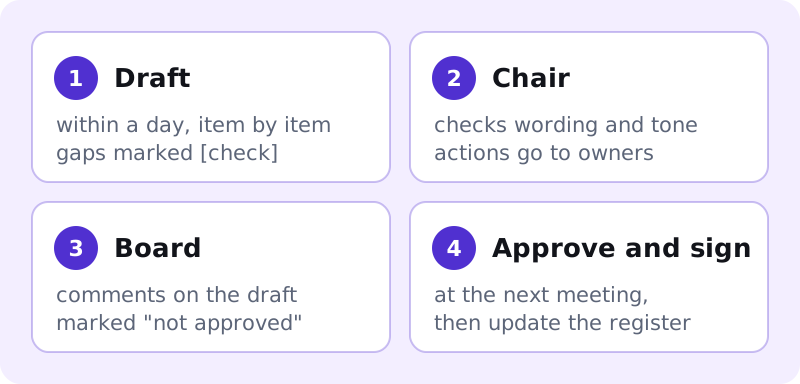
- Write the draft within a day, item by item, while memory is fresh. Mark every gap as [check].
- Send the draft to the chair only. The chair checks resolution wording and tone.
- Send the action items to their owners now. They should not wait for formal approval.
- Circulate the draft to all directors, marked "draft, not approved", with a date for comments.
- Approve at the next meeting, then sign. File the signed version and update the decisions register.
Most of the drift that follows meetings starts with actions that were never sent. Our post on action-item drift covers that side.
Where does a board portal fit?
In Konsaro, the minutes editor records attendance and decisions and tasks per agenda item, keeps comments and a version history, and lets the board office share the draft with selected people before publishing it. The Minutes Copilot drafts minutes from a Teams, Zoom or Webex transcript for the board office to review. See minutes and follow-up and the overview for the corporate secretary.
Frequently asked questions
Should board minutes include who said what?
Only where it matters: a vote against with reasons, a declared conflict, or a question a director explicitly wanted recorded. Otherwise, summarise the discussion without attributing remarks.
Can we keep the recording instead of minutes?
No. A recording or transcript is raw material, not the minutes. Decide in advance how long recordings and transcripts are kept and delete them under that rule once the minutes are signed.
How soon should minutes be sent?
There is rarely a legal deadline. A draft to the chair within a day or two, and to the full board within a week, keeps memories fresh and actions moving.
Who approves board minutes?
Usually the board at its next meeting, after which the chair and secretary sign. Some boards approve by circular resolution if their rules allow it.
Do executive committee minutes need the same detail?
Usually less. Action minutes with decisions and owners are often enough for a management team, while a board should show the basis of its decisions.
How do I minute a conflict of interest?
Name the director, the item, the conflict in a few words and the measure the board decided, for example that the director leaves the room. Add the times if the director left and returned. For Swiss companies, Art. 717a CO is the basis for the disclosure.
Can I fix minutes after they were approved?
Do not edit the signed version. Record the correction in the minutes of the next meeting, with a reference to the item and the original wording, and file both.
What is the difference between minutes and a decisions register?
Minutes record the meeting: attendance, discussion summary, resolutions, votes. A register lists decisions across meetings so that you can find them. See decisions register versus minutes.
Sources
- Swiss Code of Obligations (SR 220), Art. 713: board resolutions and minutes (checked 29 October 2026)