

Board meeting agenda template: order, timings, labels
—8 min read
Put the formal items first and keep them short, then a consent agenda for routine approvals, then the most important decision while the board is fresh, then discussion items, and reports last. Give every item a start time and a duration, and leave about ten per cent of the meeting as a buffer. If the total does not fit, move items out before the agenda goes out.
Which columns does the agenda template have?
A list of topics is not yet an agenda. The template has seven columns, and each one answers a question a director would otherwise ask by email.
| Column | Content | Question it answers |
|---|---|---|
| No. | Running number, with sub-numbers for the consent agenda (3.1, 3.2) | How do we refer to it in the minutes? |
| Start · min. | Start time and duration in minutes | When does it start, and how long may it take? |
| Item | Title as an outcome or topic, not “Finance” | What is this about? |
| Type | Decision, discussion or information | What is expected of me? |
| Lead | One person who introduces the item | Who answers questions? |
| Paper | Title and page count, or “none” | What do I read beforehand? |
| Question for the board | One sentence for decision and discussion items | What exactly are we asked? |
The last column is the one most templates miss. An item that reads “Digital strategy” invites a presentation; an item with the question “Which of the two options should management develop into a plan?” invites a discussion. Our posts on labelling every item and the order of business explained go deeper into both.
In what order should board agenda items go?
Most boards follow the same order of business, and for good reason: formal items settle whether the meeting can decide, the consent agenda clears routine approvals, and the remaining time goes to substance. The common mistake is to open with a long CEO report and push the key decision to the last hour.
- Opening: attendance, quorum if your rules set one, conflicts of interest, agenda approved.
- Minutes of the last meeting and the action log.
- Consent agenda: routine approvals in one vote.
- The most important decision item.
- Further decision items.
- Discussion items: strategy, risks, topics without a decision today.
- Reports: CEO, finance, committees. Short, with questions only.
- Any other business: announcements only.
- Session without management, then close.
Some boards prefer a short CEO update at the start, as context for the decisions. That works if it is kept to ten minutes and the detail stays in the paper.
How much time should each item get?
Time follows the label. Decision and discussion items need the most, information items the least. As a rough guide for a half-day meeting:
| Item type | Typical time | What drives it |
|---|---|---|
| Opening and formal items | 10 minutes | Fixed; should never grow |
| Consent agenda | 5 minutes | Only grows if an item is taken out |
| Main decision item | 45–60 minutes | Complexity, risk, how contested it is |
| Other decision items | 15–30 minutes each | Whether the board has seen it before |
| Discussion item | 30–45 minutes | Whether a clear question is put to the board |
| Reports | 10–15 minutes each | Questions only; papers read in advance |
| Session without management | 15 minutes | Fixed |
| Buffer | About 10 per cent | Kept free, not filled |
These are editorial starting points, not rules. What matters is that the durations add up before the agenda goes out. For a method to set each duration, see timed agendas.
What does a timed sample agenda look like?
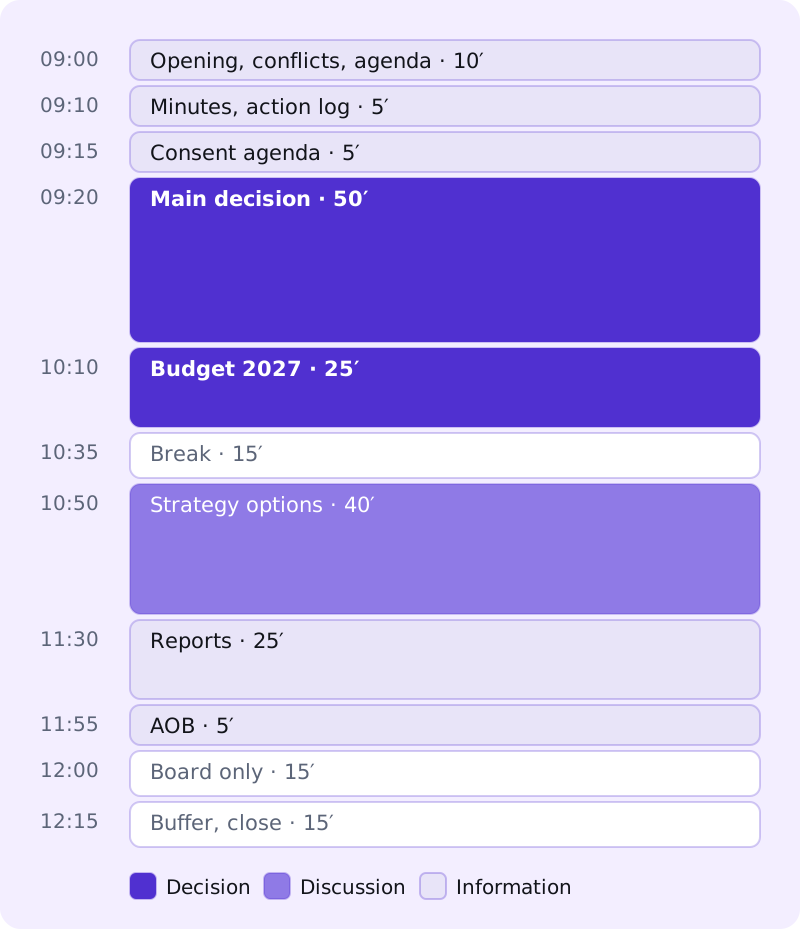
| Start | Min. | Item | Type | Lead | Paper |
|---|---|---|---|---|---|
| 09:00 | 10 | 1 Opening, quorum, conflicts, agenda | Decision | Chair | — |
| 09:10 | 5 | 2 Minutes and action log | Decision | Board office | Minutes, log |
| 09:15 | 5 | 3 Consent agenda (3.1–3.3) | Decision | Chair | 3 papers |
| 09:20 | 50 | 4 Acquisition of company X | Decision | CEO | Paper 4 (14 p.) |
| 10:10 | 25 | 5 Budget 2027 | Decision | CFO | Paper 5 (9 p.) |
| 10:35 | 15 | Break | — | — | — |
| 10:50 | 40 | 6 Digital strategy: options | Discussion | CEO | Paper 6 (6 p.) |
| 11:30 | 25 | 7 CEO, finance and committee reports | Information | CEO, CFO | Report pack |
| 11:55 | 5 | 8 Any other business | Information | Chair | — |
| 12:00 | 15 | 9 Session without management | — | Chair | — |
| 12:15 | 15 | Buffer; close | — | Chair | — |
All names and figures in the sample are invented. The pattern to copy: the two decisions come before the break, the discussion item gets a full 40 minutes because it has a clear question, and the reports are 25 minutes in total because the board read them beforehand.
How do you build the agenda step by step?
- Collect topics: from the minutes of the last meeting, the action log, the annual calendar and requests from directors or management.
- Decide the type of each topic. A topic without a clear type or question is not ready for the agenda.
- Name a lead and a paper for every item. No paper means the item is information only, or it waits.
- Estimate durations and add them up, plus ten per cent buffer. Compare with the time available.
- Cut and move items until the total fits, with the chair.
- Fix the order: formal items, consent agenda, main decision, other decisions, discussion, reports.
- Send the agenda with the papers within the notice period set by your articles or organisational regulations, and mark in the agenda what changed since the draft.
Most of the work happens in steps 2 to 5, weeks before the meeting. If the agenda is built in the last two days, the papers are usually late too.
How do you cut an agenda that is too full?
If the durations add up to more than the meeting, decide before the agenda goes out, together with the chair. Options, in order of preference:
- Turn reports into papers for information, with questions sent in advance.
- Move routine approvals into the consent agenda.
- Defer discussion items that have no deadline to the next meeting.
- Take a clear-cut decision by circular resolution before or after the meeting.
- Only as a last resort: extend the meeting, and tell members early.
An agenda that runs over has a cost: the last items get rushed, and the minutes later show decisions with little discussion. Our post on the chair's pre-read shows how much is decided before the meeting. For the circular route, the circular resolution template has the documents.
How does the template change for other meeting lengths?
| Format | Agenda shape | Watch out for |
|---|---|---|
| Two hours | Formal items 10 min, consent agenda 5, one main decision 40, one discussion 30, reports as papers only, buffer 15 | No room for a second decision; move it to a circular resolution |
| Half day (above) | Two decisions, one discussion, short reports, break | Reports creeping back into presentations |
| Full day or retreat | Regular meeting in the morning; strategy session in the afternoon with its own agenda and preparation | Mixing the two: the decisions of the day should be taken before the strategy session starts |
How should an executive team agenda differ?
A management meeting is shorter and more frequent, so the agenda is leaner: actions due this week, one or two decisions, one discussion topic, a quick round of updates with a time limit, and one fixed item that links to the board: which papers go to the next board meeting, who writes them and by when.
What do the board's own rules change?
The articles of association and the organisational regulations can set the notice period for the invitation, who may add items and whether the board votes on the agenda at the start. Check them before you fix the template's deadlines. Whatever the rules say, the board has to be properly informed, and the duty to ensure proper reporting to board members (Art. 716a para. 2 CO) is a good reason to send papers early. A late addition belongs in the opening item, where the board decides whether to take it.
Where does the agenda live in a board portal?
In Konsaro, each agenda item has a type (approval, information or discussion) and a duration in minutes, and agenda templates and saved meeting presets can be reused within a board or committee. Papers sit with their item. See meetings and agenda and board materials.
Frequently asked questions
What is the standard order of a board meeting agenda?
Opening and formal items, minutes and action log, consent agenda, decision items, discussion items, reports, any other business, a session without management and the close.
Should the CEO report come first or last?
Either works if it stays short. A ten-minute update at the start gives context; a long report at the start eats the time the decisions need.
How long should a board meeting be?
There is no rule. Many boards meet for half a day. The right length is the sum of the item durations plus a buffer, not a fixed slot that items are squeezed into.
What is a consent agenda?
A group of routine items approved in one vote without discussion. Any director can ask for an item to be taken out and dealt with separately.
Who decides what gets cut?
The chair, usually on the board office's proposal. Directors should know in advance which items moved and why.
When should the agenda go out?
The notice period comes from your articles or organisational regulations. Send the agenda together with the papers, so directors can prepare.
Can a director add an item?
Usually yes, through the chair or the board office before the agenda is final. Items raised during the meeting go under any other business, which is for announcements, not decisions.
Sources
- Swiss Code of Obligations (SR 220), Art. 713: board resolutions, including by circular resolution (checked 29 October 2026)
- Swiss Code of Obligations (SR 220), Art. 716a para. 2: proper reporting to board members (checked 29 October 2026)