
What is a board book? Contents, order and length
—11 min read
A board book, often called a board pack in the UK, is the set of documents the board receives before a meeting: the agenda, the minutes of the last meeting, the papers for each agenda item and the regular reports from management. It exists so that directors can arrive prepared and spend the meeting deciding, not reading. Its order follows the agenda, and its length should be limited by what a director needs to decide.
What is the board book for?
The board book is how the board gets the information it needs to do its job. Swiss law gives every member the right to information about all matters of the company (Art. 715a CO) and makes the board responsible for appropriate reporting to its members (Art. 716a para. 2 CO). It is the routine form of that reporting.
The Swiss Code of Best Practice for Corporate Governance (economiesuisse, 2023) puts it plainly: members should generally receive well-presented, clearly organised and comprehensible documentation before the meeting. Where that is not possible, the chair should make the documents available for study with sufficient time before the meeting. The Code is aimed at listed companies, but the principle applies to any board.
Other names for the same thing: board pack (the usual term in the UK), board papers, meeting book, briefing pack. In German-speaking Switzerland, the usual term is Sitzungsunterlagen or VR-Unterlagen.
Board book, board pack, board papers: do the terms differ?
Mostly they do not. Which word you meet depends on the country and on the person. The table helps when you search, brief an assistant or read a vendor page.
| Term | Where you meet it | Usually means |
|---|---|---|
| Board book | North America, often in portal products | The whole set for one meeting, in one document or one folder |
| Board pack | UK, Ireland, Australia and many portals | The same |
| Board papers | Company practice in many countries | The individual papers; sometimes the whole set |
| Sitzungsunterlagen, VR-Unterlagen, Dossier | German-speaking Switzerland | The same |
| Reading room, data room | Transactions, large boards | A reference folder behind the board book. Not the pack itself |
One distinction is worth keeping: the pack is what the board must read to decide; the reading room is what it may consult. If everything is "in the pack", directors cannot tell the difference.
What goes into a board book?
Most board books contain the same building blocks. The table shows them in the order many boards use, with what each part is for.
| Part | What it contains | Why it is there |
|---|---|---|
| Agenda | Items, owners, durations and the action requested (decide, discuss, note) | Table of contents and the plan for the meeting |
| Minutes of the last meeting | Draft minutes for approval, with the decisions taken | Corrections are made before they are signed |
| Open actions | Action items from earlier meetings with owner, due date and status | Shows whether last time's decisions were carried out |
| Decision papers | One paper per proposal, with a cover sheet and the resolution wording | The core of the meeting; directors read these first |
| Discussion papers | Strategy questions, early-stage proposals, options | Gives the board a say before a decision is due |
| Management reports | CEO report, financial results, risk and compliance updates | Regular oversight; often the largest part |
| Committee reports | Short summaries from audit, compensation or other committees | Brings committee work to the full board |
| Information items and appendices | Background documents, contracts, detailed data | Available for reference, not required reading |
In which order should the papers appear?
Follow the agenda, and put decisions before reports. A director with limited time reads from the front. If the front of the board book is forty pages of monthly figures, the proposal that needs a vote gets the least attention.
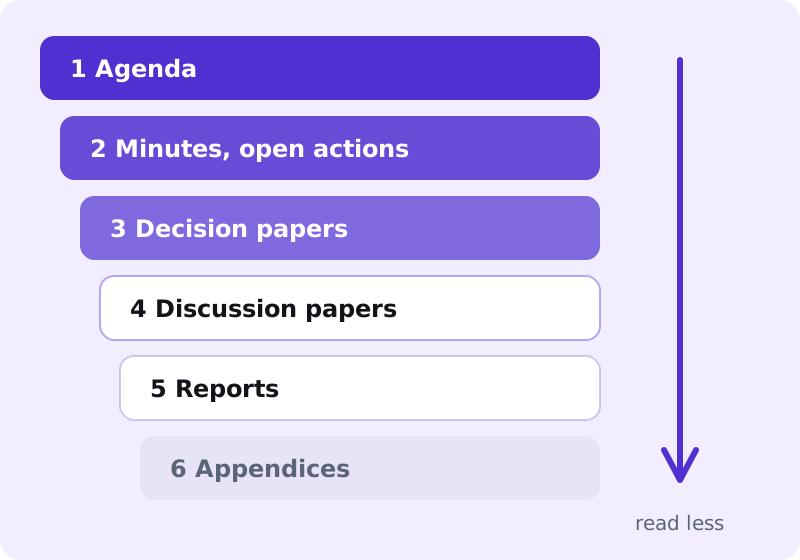
Two practical rules help. First, number the papers with the agenda item they belong to (paper 4.1 belongs to item 4), so the board book and the agenda can never drift apart. Second, keep appendices separate from the paper itself. A ten-page decision paper with sixty pages of attachments is a ten-page paper; the attachments are for reference.
How long should a board book be?
There is no legal or generally accepted page limit. What matters is whether a director can read the whole board book carefully in the time the board has agreed for preparation. If that is not possible, the book is too long, whatever the page count.
Boards that keep board books readable usually agree a few rules with management:
- A page limit per paper (for example a few pages), with everything else in appendices.
- A cover sheet on every paper that states the decision requested, the recommendation and the key risks.
- Reports that show changes and exceptions, not every number every time.
- No paper without an owner and a clear label: for decision, for discussion or for information.
- A review of board book length in the regular board evaluation.
Length also depends on the meeting. A strategy or budget meeting needs more reading than a routine quarterly meeting. Plan the reading time with the agenda, not afterwards.
What does a board book look like in practice?
Here is the table of contents for a quarterly meeting of the fictional Muster AG (invented for illustration). Each paper carries the number of its agenda item, a label and a page budget; the page budgets are an example of a rule a board could set, not a recommendation.
| No. | Paper | Label | Pages |
|---|---|---|---|
| 1 | Agenda with times and owners | Note | 2 |
| 2.1 | Draft minutes of the last meeting | Decision (approve) | 4 |
| 2.2 | Open action items | Note | 1 |
| 3.1 | Proposal: lease for new premises, with cover sheet | Decision | 4 |
| 3.2 | Proposal: dividend recommendation to the general meeting | Decision | 3 |
| 4.1 | Strategy options for the southern market | Discussion | 6 |
| 5.1 | CEO report (changes and exceptions only) | Note | 4 |
| 5.2 | Financial results and forecast | Note | 5 |
| 5.3 | Risk and compliance update | Note | 3 |
| 6.1 | Audit committee summary | Note | 2 |
| A | Appendices: draft lease, valuation report, detailed figures | Reference | not counted |
Three things to notice. The two decision papers come before the reports, even though the reports are more routine. Every paper has a label, so a director with an hour left knows what to read first. And the appendices sit outside the page count: the board relies on the paper, not on the attachment.
What should a cover sheet say?
A cover sheet is the single most useful habit for a board book, because it turns a paper into a question the board can answer. Keep it to one page. The fields below are a sample; the sample wording refers to the Muster AG lease above.
| Field | Sample wording |
|---|---|
| Agenda item and label | 3.1, for decision |
| Decision requested | Approve the lease for the new office premises and authorise the CEO and the CFO to sign jointly. |
| Recommendation | Management recommends approval. |
| Why now | The landlord holds the offer until the date of the meeting. |
| Alternatives considered | Two other sites, dropped on cost and access. |
| Key risks | Early termination is possible only on the terms set out in section 7 of the draft lease. |
| Conflicts of interest | None known. Members of the board and management with a conflict must inform the board without delay and in full (Art. 717a CO). |
| Owner and contact | CFO, with the legal counsel for the lease |
The cover sheet also makes the minutes easier. The minute-taker can write "the board had paper 3.1" and the resolution wording is already in the paper. How the two documents work together is in the post on Swiss board minutes. A longer template is in the board book template.
How much can a director read?
Instead of arguing about page counts, test the board book against the reading time the board has agreed. A simple method: ask two directors to time how long the last board book actually took them, from first page to last question, and compare it with the time they said they had. If it took longer, cut or move material to the appendices before the next meeting; do not extend the deadline as the first reaction. For the reading side, see a method for directors, and for the argument for shorter packs why board books should be shorter.
When should the board book reach the directors?
Swiss law does not set a deadline for board papers. Boards set their own, usually in the organisational regulations or a board decision: a fixed number of days before the meeting, with a rule for papers that arrive late. The right number depends on board book size, how often the board meets and how far directors have to travel. The trade-off is freshness against reading time.
Whatever the period, two things count more than the number. Everyone gets the same version at the same time, and late changes are visible. The post on one current board book explains why version drift is the most common failure once a board book has gone out.
Which papers should not go to everyone?
A board book is not one list for everybody. Some items need a narrower circle, and the regulations should say who decides.
- Items on which a member has a conflict of interest: the board decides how to handle it (Art. 717a CO). Many boards keep the papers back from the member, or use a separate item. Every member has the right to ask for information about the company's affairs (Art. 715a CO), so a restriction should rest on a rule or a board decision, not on the secretary's habit.
- Guests and presenters: give them the paper for their item only, for the duration of that item.
- Committee material: the full board gets a summary, the committee keeps the detail unless the full board asks.
- Personnel and remuneration items: often a separate, restricted paper.
- Late additions: treat them as an exception with a stated reason. A policy for late papers is described in the late papers post.
Paper binders are not the issue here; printed board books can follow the same rules.
What goes wrong with board books?
- The board book is a collection of attachments in several emails, and nobody knows which version is current.
- Papers do not say what the board is asked to do, so directors read everything with the same attention.
- Reports dominate and decision papers sit at the back.
- Papers arrive the evening before, and the meeting turns into a reading session.
- Confidential papers go to everyone, including guests who only attend one item.
Late papers also change what the chair sees before the meeting. The wrong PDF in the room walks through one such case.
How does a board portal handle the board book?
In a board portal, the agenda and the board book are one thing: each paper is attached to its agenda item, and everyone opens the current version. In Konsaro, papers are uploaded as PDF files to each item, each item has a type (approval, information or discussion) and a duration, access can be restricted per paper or per item, and published board books keep version snapshots when a paper is replaced. See board materials and the overview for the corporate secretary.
Frequently asked questions
Is a board book the same as board minutes?
No. The board book is what directors read before the meeting. The minutes record what was discussed and decided at the meeting. The draft minutes of the previous meeting are usually part of the next board book, for approval.
Who prepares the board book?
Usually the board secretary or board office, with papers written by management and the agenda agreed with the chair. The chair is responsible for making sure the information arrives in good time.
Should the board book include management's monthly reports?
Include what the board needs for oversight, ideally a short summary with changes and exceptions. Detailed data can go into appendices or a separate reading room so it does not crowd out the decision papers.
Can directors ask for more information than the board book contains?
Yes. Under Art. 715a CO, every member can request information about all matters of the company. Outside meetings, information about individual transactions needs the chair's authorisation, and the board decides if the chair refuses.
Should guests receive the full board book?
No. Guests who attend for one item should receive only the papers for that item. Restricting access per paper is easier in a board portal than by email.
What is the difference between a board book and a board portal?
The board book is the content: the papers for one meeting. A board portal is the software that holds, shares and secures it. Many boards used e-mail and PDFs for years and added a portal when version control and access control became the main problem.
How many papers is too many?
There is no set number. If every agenda item has a paper and the board cannot read them in the time it set aside, the board book has too many or too long. Fix it by moving background material to appendices or a reading room.
Should the draft minutes of the last meeting be in the board book?
Yes, as a decision item, so corrections are made before signature. See the post on approving board minutes for the alternatives.
Sources
- Swiss Code of Obligations (SR 220), Art. 715a and 716a: fedlex.admin.ch (checked 29 October 2026)
- economiesuisse: Swiss Code of Best Practice for Corporate Governance (2023), PDF (checked 29 October 2026)
- Swiss Code of Obligations (SR 220), Art. 717a: conflicts of interest (German text) (checked 29 October 2026)