

Swiss board meeting agenda: structure and examples
—9 min read

A good Swiss board meeting agenda starts with the formal items, puts decisions with written proposals first, keeps reports short and ends with action items and a session without management. Each item shows its type, paper, owner and time. The Code of Obligations sets no form or notice period for board meetings; the articles or organisational regulations can.
What does Swiss law say about the board agenda?
Less than many expect. Unlike the general meeting, board meetings have no statutory notice period and no duty to announce items in advance. The following rules still shape the agenda.
| Rule | Content | Effect on the agenda |
|---|---|---|
| Art. 713 para. 1 CO | Majority of votes cast, chair's casting vote unless the articles say otherwise | Decision items need clear resolution wording to vote on |
| Art. 713 para. 2 CO | Decisions at a meeting with a venue, by electronic means, or in writing unless a member asks for oral deliberation | The invitation states the meeting format |
| Art. 713 para. 3 CO | Minutes of deliberations and resolutions, signed by the chair and the secretary | Agenda numbers become the structure of the minutes |
| Art. 715 CO | Any member may demand that a meeting be called without delay, giving reasons | Members have a route to put topics on the agenda |
| Art. 715a para. 3 CO | Between meetings, information on the course of business; on individual matters with the chair's authorisation | Sending papers early leaves time for questions |
| Art. 717a CO | Members inform the board promptly about conflicts of interest | A fixed "conflicts of interest" item at the start |
| Art. 716b para. 3 CO | Organisational regulations govern management's reporting | Report items follow the regulations |
What the law leaves open, the board decides. One published example: the organisational regulations of Emmi AG (as of 24 January 2023) provide that the invitation with the agenda and the papers are normally sent no later than seven days before the meeting, with an exception for extraordinary situations. Other companies choose other periods; what matters is that the regulations set one. How such regulations are structured is covered in organisational regulations of the board.
How is a board agenda structured?
In five blocks that stay the same at every meeting. The order follows the attention in the room: decisions come first, reports can be shortened when they are in writing.
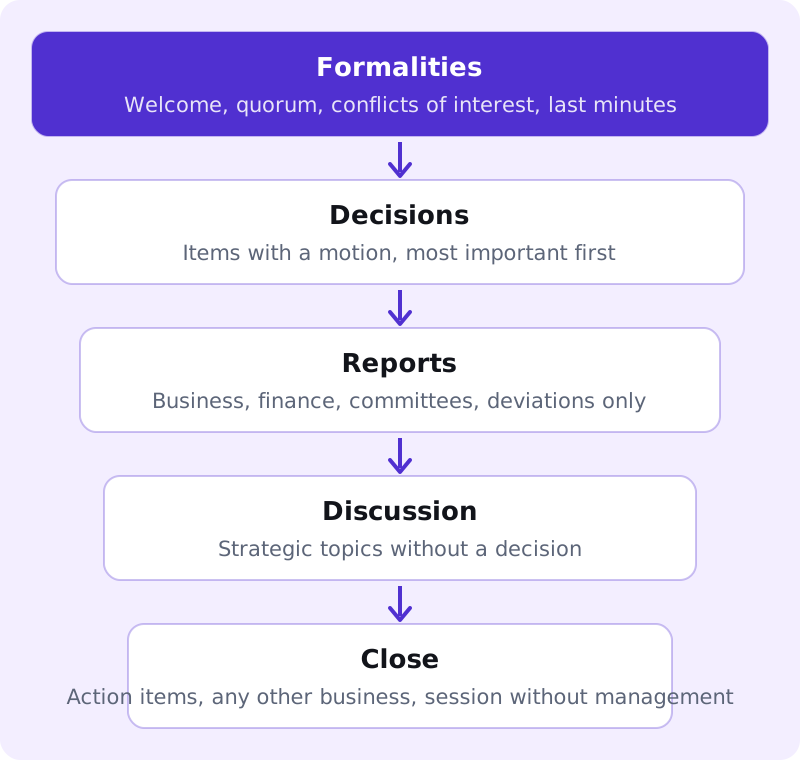
| Block | Content | Purpose |
|---|---|---|
| 1. Formal | Welcome, quorum, conflicts of interest, minutes of the last meeting | A legally clean start |
| 2. Decisions | Proposals with resolution wording, most important first | Decide while everyone is fresh |
| 3. Reports | Course of business, finance, committees; in writing, questions only | Supervision without reading aloud |
| 4. Discussion | Topics with no decision, clearly labelled | Early thinking for later decisions |
| 5. Close | Action items, any other business, next meeting, session without management | Nothing gets lost |
Each item should have a title that names the topic, a type (decision, discussion or information), the paper, the person presenting and a time. Why the type changes so much is explained in decision, discussion and information agenda items; how to set the times is shown in the timed board agenda.
What does a three-hour template look like?
| No. | Item | Type | Paper | Time |
|---|---|---|---|---|
| 1 | Welcome, quorum, conflicts of interest | Formal | – | 5 min |
| 2 | Approval of the minutes of the last meeting | Decision | Draft minutes | 5 min |
| 3 | Capital expenditure proposal: production line | Decision | Proposal, business case | 40 min |
| 4 | Budget for next year | Decision | Budget, notes | 40 min |
| 5 | Course of business and finance | Information | Monthly report | 20 min |
| 6 | Committee reports | Information | Short reports | 15 min |
| 7 | Succession planning for management | Discussion | Discussion paper | 30 min |
| 8 | Action items, any other business, next meeting | Formal | Action list | 10 min |
| 9 | Session without management | Discussion | – | 15 min |
That adds up to three hours. Plan breaks too: for anything over two hours, a short break after the decision block helps. A fill-in template is available in the board meeting agenda template.
How does the agenda change through the year?
The structure stays; the decision items change. An annual plan sets which recurring topics belong to which meeting. The overview below shows one possible split over four regular meetings; the Swiss Code recommends at least four meetings a year.
| Meeting | Main decision items | Notes |
|---|---|---|
| Year-end meeting | Financial statements, annual and where required management report, proposal on the appropriation of profit, preparation of the general meeting | The auditor often attends the year-end item |
| Meeting after the general meeting | Constitution, committees, signing authority, annual plan | New members: plan an induction |
| Strategy meeting | Strategy, risk assessment, self-evaluation | Often a retreat with more time |
| Budget meeting | Budget, medium-term plan, management's objectives | After strategy and risks so everything fits |
Extraordinary meetings come on top. They often have only one decision item but should still start with quorum, conflicts of interest and minutes. For the rest of the year, see the annual board calendar.
Who sets the agenda, and by when?
The chair is responsible for the agenda, usually together with the CEO and the board secretary. A fixed timeline keeps proposals from arriving at the last minute.
| When | What | Owner |
|---|---|---|
| 4 weeks before | Draft agenda from the annual plan, action items and management proposals | S, C |
| 3 weeks before | Agree with the CEO; members can request items | C, M, B |
| 2 weeks before | Send the invitation with the agenda | S |
| 1 week before | All papers delivered | S, M |
| After the meeting | Draft minutes following the agenda numbers, update action items | S |
Sample invitation
What about any other business and items not on the agenda?
Any other business is meant for announcements and short questions, not decisions. The Code of Obligations does not expressly forbid the board from deciding on items not on the agenda. A member who could not prepare can, however, ask for the topic to be deferred, and the organisational regulations can govern this. If the board decides anyway, record in the minutes that all members present agreed to decide on it.
What is the session without management for?
A short session without management is a good way to close every meeting. It is not for deciding behind management's back but for discussing performance, cooperation and succession openly. So that nobody becomes suspicious, put it on every agenda, even if it sometimes lasts only five minutes. More in the in-camera session.
Which agenda mistakes come up most often?
- "Miscellaneous" as a title. Every topic gets its own title.
- Decisions without a proposal. Without written resolution wording, neither the vote nor the minutes will be clean.
- Reports first. Starting with 60 minutes on the course of business means deciding under time pressure at the end.
- Too many items. Routine decisions can be bundled into a consent agenda if the regulations allow it.
- No times. Without times nobody notices that the agenda does not fit the meeting.
- The session without management appears only when there is a problem. Then it looks like a vote of no confidence.
What is different for a GmbH, foundation or association?
In a GmbH, several managing directors decide by a majority of votes cast, with the chair's casting vote unless the articles say otherwise (Art. 809 para. 4 CO). The agenda looks much like the board's, usually without committee reports. For a foundation board, the deed of foundation sets the organisation (Art. 83 CC); for an association, the articles do (Art. 69 CC). Check there whether notice periods, quorum or written resolutions are regulated before you adopt the template.
In Konsaro each agenda item has a type (approval, information or discussion) and a duration in minutes, agenda templates can be reused, and access can be restricted per agenda item, for example for the session without management. More under meetings and agendas and, for the secretariat, corporate secretary.
Frequently asked questions
Is there a legal notice period for Swiss board meetings?
No. The Code of Obligations sets no notice period for board meetings. It is usually set in the organisational regulations; Emmi AG's published regulations, for example, say normally seven days.
Who prepares the board agenda?
Usually the chair with the CEO and the board secretary, based on an annual plan and the action list. Members can request items.
Can a member demand a meeting or an agenda item?
Any member may ask the chair to call a meeting without delay, giving reasons (Art. 715 CO). How items are requested for a regular meeting should be set in the organisational regulations.
How does a Swiss board take decisions?
By a majority of votes cast; the chair has the casting vote unless the articles say otherwise (Art. 713 para. 1 CO). Quorum requirements are set by the articles or regulations.
Can the board decide on a topic not on the agenda?
The Code of Obligations does not expressly forbid it. It is safer to decide only if all members present agree and to record that in the minutes. The organisational regulations can set stricter rules.
How many items can one meeting take?
It depends on length and type. With a time per item you see early whether the agenda fits; routine decisions can be bundled and reports sent in writing beforehand.
Should a session without management be on the agenda?
It is not a legal duty, but it lets the board discuss performance and succession openly. When it is on every agenda, it does not signal distrust.
Sources
- Swiss Code of Obligations (SR 220), Art. 713: board resolutions and minutes (unofficial English translation) (checked 29 October 2026)
- Swiss Code of Obligations (SR 220), Art. 715: right to call a meeting (unofficial English translation) (checked 29 October 2026)
- Swiss Code of Obligations (SR 220), Art. 715a: right to information (unofficial English translation) (checked 29 October 2026)
- Swiss Code of Obligations (SR 220), Art. 716b: organisational regulations (unofficial English translation) (checked 29 October 2026)
- Swiss Code of Obligations (SR 220), Art. 717a: conflicts of interest (unofficial English translation) (checked 29 October 2026)
- Swiss Code of Obligations (SR 220), Art. 809: management of the GmbH (unofficial English translation) (checked 29 October 2026)
- Swiss Civil Code (SR 210), Art. 69 and 83: association committee, foundation bodies (unofficial English translation) (checked 29 October 2026)
- Emmi AG, organisational regulations (as of 24 January 2023), section 3.3 meetings and resolutions (German) (checked 29 October 2026)
- economiesuisse, Swiss Code of Best Practice for Corporate Governance 2023 (English, PDF), section on the board's method of working (checked 29 October 2026)