

How to prepare a Swiss board meeting: 4-week checklist
—11 min read

Prepare a Swiss board meeting about four weeks ahead: set the agenda, collect proposals, review the papers and send the complete board book at least a week before the meeting. The Code of Obligations (CO) sets no notice period for board meetings; the articles of association and the organisational regulations do. What the law does fix are the voting rules in Art. 713 CO and each member's right to information (Art. 715a CO).
What does Swiss law require for a board meeting?
Surprisingly little. The CO says how a board decides, not how far in advance it must be invited. Art. 713 para. 1 CO says resolutions pass with the majority of the votes cast, with a casting vote for the chair unless the articles say otherwise. Art. 713 para. 2 CO lets the board decide at a meeting with a venue, by electronic means (applying Art. 701c to 701e CO by analogy), or in writing on paper or electronically; the written route is open only as long as no member asks for an oral discussion. Art. 713 para. 3 CO requires minutes, signed by the chair and the minute-taker.
Three more provisions shape the preparation. Under Art. 715 CO, any member may ask the chair, giving reasons, to call a meeting without delay. Under Art. 715a CO, any member may request information on all affairs of the company; in meetings, all members and the people entrusted with management must answer, and outside meetings a member can ask management about the course of business and, with the chair's authorisation, about individual transactions. Under Art. 717a CO, members of the board and of management must inform the board immediately and completely about conflicts of interest affecting them, and the board takes the measures needed to protect the company. A complete board book answers many information requests before anyone makes them.
| Topic | Where it is set | What to decide yourself |
|---|---|---|
| Notice period | Articles or organisational regulations; the CO is silent | Set one number of days for ordinary meetings and a shorter one for urgent ones |
| Attendance quorum | Articles or organisational regulations; the CO sets none | Majority of members, or a fixed number, and whether remote participants count |
| Majority and casting vote | Art. 713 para. 1 CO; articles may differ on the casting vote | Keep the legal default or depart from it on purpose |
| Meeting format | Art. 713 para. 2 CO | Which formats are allowed, and how members identify themselves online |
| Minutes | Art. 713 para. 3 CO | Who drafts, who approves, and by when the draft is due |
| Information to members | Art. 715a CO | What goes into the standard board book, and who may add papers |
| Conflicts of interest | Art. 717a CO | How a conflict is reported before the meeting and what the chair does with it |
So start with your organisational regulations. Many set a notice period, an attendance quorum and a procedure for urgent business. If yours say nothing, a short directive from the chair fixes the gaps. For a model, see our post on the organisational regulations of the board. How quorum turns into a problem on the day itself is covered in late arrivals and quorum uncertainty.
What does the four-week plan look like?
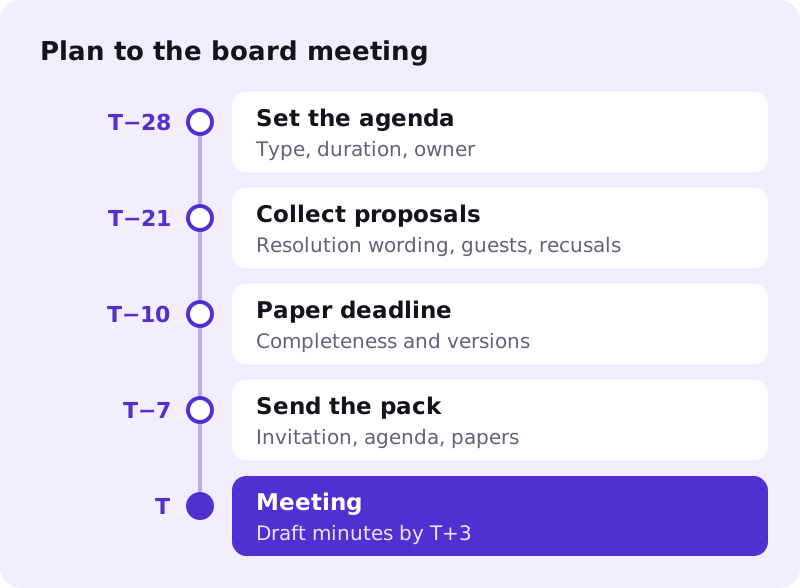
A plan counted back from the meeting date takes the pressure out of the last week. The points below are guide values for an ordinary meeting; they are our suggestion, not a legal requirement. Adjust them to your regulations and to how long your papers take to produce.
Week 4: set the agenda
The chair sets the agenda with the CEO. Start from the annual plan, the open action items from the last meeting and requests from members. Give every item a type (decision, discussion or information), an owner and a duration in minutes. Planning time per item shows early when the agenda is too long for one meeting. If you need a starting point, use the agenda template and think about the order of items.
Week 3: collect proposals and papers
The board office sends management the list of papers needed and the paper deadline. Every decision item needs the proposed resolution written out, because the minutes will need that wording too. This is also the week to confirm guests for single items and to ask members whether any conflict of interest affects an item. Our post on the conflict of interest declaration shows a form for this.
Week 2: review the papers
At the paper deadline, the board office checks completeness and the chair checks quality. If a paper is missing, the chair decides: defer the item, take it for information only, or accept a late addition. Make sure each paper exists in one version only; parallel versions are the most common source of errors, as our post on one current board book shows. A short late papers policy saves the argument every time a paper is late.
Week 1: invitation and board book
At least seven days before the meeting, the invitation, agenda and all papers go out together. The invitation states date, time, venue or video link, the agenda items with their type and the proposals. Ask for attendance at the same time so you can judge the quorum in advance. Two days before, remind members who have not opened the papers yet.
What belongs in the invitation?
A good invitation is complete without anyone having to ask. Cover these points:
- Date, start and expected end, venue or video link
- Agenda with type (decision, discussion, information) and time per item
- Proposed resolutions in full wording
- All papers in their final version, with confidential papers marked
- Guests and the items they attend
- Deadline to confirm attendance or send apologies
- Known conflicts of interest and planned recusals
What does a finished agenda item look like?
The most useful single habit is to write each decision item so that it can be copied into the minutes. The example below is invented; Muster AG does not exist.
| No. | Item | Type | Time | Owner | Paper |
|---|---|---|---|---|---|
| 3 | Approval of the budget 2027 | Decision | 25 min | CFO | Budget 2027 (PDF, 12 pages) |
| 4 | Status of the ERP project | Discussion | 20 min | CIO | Steering committee report |
| 5 | Quarterly compliance report | Information | 5 min | Head of Legal | One-page summary, read in advance |
The proposed resolution for item 3 then reads, in the invitation: «The Board of Directors approves the budget 2027 as presented in the paper of [date], with total expenses of CHF [amount].» If the board amends the figure in the meeting, the minutes record the amended wording. Information items such as item 5 are the first candidates to move out of the meeting and into a paper that members read beforehand; see the consent agenda.
How do you secure the quorum in advance?
Ask for attendance early and know the rules in your regulations. Swiss law sets no attendance quorum for the board; the articles or the organisational regulations do. If too few members can attend, you have three options: move the date, allow participation by video, or move single decisions to a circular resolution. The last one only works as long as no member asks for an oral discussion (Art. 713 para. 2 no. 3 CO). Participation by video is covered in our post on virtual board meetings.
What changes for urgent meetings?
Because the CO sets no period, an urgent meeting is a question of what your regulations allow. Good regulations name the shortest permitted notice, say who may call an urgent meeting and require that urgent invitations still state the reason and the proposed resolution. When time is short, a short call or a circular resolution often does the job; the chair should still send papers first and note in the minutes why the shorter notice was used. Our post on urgent board decisions goes into the options.
Checklist: preparing a board meeting
Use this list for every ordinary meeting. Times count back from the meeting day (T).
| When | Task | Owner |
|---|---|---|
| T−28 | Set the agenda with type and duration per item | Chair with CEO |
| T−28 | Review open action items from the last meeting | Board office |
| T−21 | Request papers and proposed resolutions from management | Board office |
| T−21 | Invite guests and ask members about conflicts of interest | Chair, board office |
| T−10 | Paper deadline: check completeness and versions | Board office |
| T−9 | Content review, decision on late papers | Chair |
| T−7 | Send invitation, agenda and papers | Board office |
| T−7 | Ask for attendance and check the quorum | Board office |
| T−2 | Remind members who have not read the papers | Board office |
| T−1 | Test room, equipment and video link | Board office |
| T+3 | Draft minutes to the chair | Minute-taker |
Who does what in the preparation?
The law assumes that the chair calls the meeting (Art. 715 CO) and has the minutes signed by the chair and the minute-taker (Art. 713 para. 3 CO). Everything between is organisation. A clear split avoids the situation in which everyone assumes someone else sent the papers.
| Role | Typical tasks | Decides |
|---|---|---|
| Chair | Sets the agenda with the CEO, reviews papers, decides on late papers and on guests | Agenda, late papers, urgent items |
| Board office or minute-taker | Keeps the calendar, requests papers, checks versions, sends the board book, tracks attendance | Nothing on content; owns the process |
| CEO and management | Write the papers and the proposed resolutions, answer questions | What is proposed |
| Members | Read the papers, report conflicts, ask questions before the meeting | How they vote |
In a small company one person often holds several of these roles. Keep the tasks separate on paper even then: it shows what falls over when that person is away.
Which mistakes cost the most time?
- Agenda items without a type: nobody knows whether a decision is expected.
- Proposals without resolution wording: the text is written in the meeting and missing from the minutes.
- Papers arrive one by one by email, and several versions circulate at once.
- No paper deadline: management delivers the evening before.
- Open action items from the last meeting never reach the new agenda.
- The notice period lives in someone's head, not in the regulations, and changes with every chair.
- Conflicts of interest are discovered during the item instead of before it.
- The invitation says «video call» without a link or a dial-in for members who cannot use the tool.
How does a board portal help with preparation?
In Konsaro, the board office builds the agenda with a type and duration for each item, attaches the papers as PDF files and publishes the meeting when everything is ready. When the agenda is published, participants can be notified by email, and people who have not prepared yet can be reminded. Open action items can be rolled forward to the next meeting. See meetings and agenda and the board office overview.
Frequently asked questions
How much notice is required for a Swiss board meeting?
The CO sets no notice period. The articles of association and the organisational regulations decide, so look there first. If they say nothing, choose a period long enough for members to read the papers properly and write it into the regulations; many boards also name a shorter minimum for urgent meetings.
Can a single director request a meeting?
Yes. Under Art. 715 CO, any member may ask the chair to call a meeting without delay, stating the reasons.
Who sets the agenda?
Usually the chair, often together with the CEO. The organisational regulations may set this out in more detail. Members can ask for items to be added.
What happens to papers that arrive late?
The chair decides. Common options are deferring the item, taking it for information only, or accepting the paper as a late addition. Write the rule down in the regulations or a directive so everyone knows it.
How many agenda items fit into one meeting?
That depends on the meeting's length and the type of items. Planning a duration for every item shows at the planning stage whether the agenda is realistic. Information items can often be handled in writing beforehand.
Can a director demand information before the meeting?
Yes, within the limits of Art. 715a CO. A member can request information on all company affairs, and outside meetings can ask the people entrusted with management about the course of business. For individual transactions the chair's authorisation is needed. If the chair refuses, the board decides.
Do the minutes of the last meeting belong in the board book?
Yes, as a draft or final version, so members can approve them at the start of the meeting. The CO only requires that minutes are kept and signed by the chair and the minute-taker; when and how they are approved is up to your regulations.
Sources
- Swiss Code of Obligations (SR 220), Art. 713: board resolutions and minutes (German text) (checked 29 October 2026)
- Swiss Code of Obligations (SR 220), Art. 715: right to call a meeting (German text) (checked 29 October 2026)
- Swiss Code of Obligations (SR 220), Art. 715a: right to information (German text) (checked 29 October 2026)
- Swiss Code of Obligations (SR 220), Art. 717a: conflicts of interest (German text) (checked 29 October 2026)