

Preparing a supervisory board meeting in Germany
—11 min read

The supervisory board (Aufsichtsrat) of a German AG must hold two meetings per calendar half-year; an unlisted company's board can resolve that one per half-year is enough (§ 110 para. 3 AktG). Preparation rests on the management board's reports under § 90 AktG, which must arrive as early as possible and usually in text form. Every meeting is minuted with a statutory minimum content, and the chair signs (§ 107 para. 2 AktG).
How often must the supervisory board meet?
§ 110 para. 3 AktG requires two meetings per calendar half-year, so at least four a year. In unlisted companies the board can resolve that one meeting per half-year is enough. Extraordinary meetings come on top: any member or the management board can ask the chair, stating purpose and reasons, to call a meeting without delay, and it must take place within two weeks of being called (§ 110 para. 1 AktG). If the chair does not act, the member or the management board can call the meeting themselves, stating the facts and an agenda (§ 110 para. 2 AktG).
| Meeting | Focus | Key papers and legal hook |
|---|---|---|
| After the audit | Accounts meeting | Annual accounts, management report, proposal on profit, audit report (§§ 170, 171 AktG); management reports on profitability (§ 90 para. 2 no. 2 AktG) |
| Before the general meeting is called | General meeting preparation | Proposed resolutions; the board's written report to the general meeting (§ 171 para. 2 AktG) |
| Mid-year | Course of business and risk | At least quarterly report on business and position (§ 90 para. 1 no. 3 AktG) |
| Late in the year | Planning for next year | Business policy and planning, including finance, investment and staffing (§ 90 para. 1 no. 1 AktG); consent catalogue |
The order and timing above are an example, not a rule. Fix next year's dates before the year starts, so members can keep them free and management can plan its reporting. Between meetings, urgent matters can be decided by written resolution without a meeting if no member objects, unless the articles or the rules of procedure provide otherwise (§ 108 para. 4 AktG).
Who calls the meeting, and with how much notice?
The chair calls the meeting. The AktG sets no general notice period: it comes from the articles or the board's rules of procedure (Geschäftsordnung). Most rules set a regular period, a shorter one for urgent cases, the form (often text form) and what the notice must contain. Our post on supervisory board rules of procedure covers those clauses in detail; this post is about the work before and after the meeting.
If the rules are silent, choose a period that lets members read the papers and agree it with your legal adviser. Who may attend is set by law: people who belong to neither the supervisory board nor the management board should not attend, but experts and informants can be called in for individual items (§ 109 para. 1 AktG).
Which papers does the board need from management?
The management board's duty to report under § 90 AktG is the backbone of every board book. Map each report to the meeting where it belongs:
| Report | When | Where it belongs |
|---|---|---|
| Intended business policy and corporate planning, with reasons for deviations from earlier targets (para. 1 no. 1) | At least once a year, sooner if the situation changes (para. 2 no. 1) | Planning meeting |
| Profitability, in particular return on equity (no. 2) | In the meeting on the annual accounts (para. 2 no. 2) | Accounts meeting |
| Course of business, in particular sales, and the company's position (no. 3) | Regularly, at least quarterly (para. 2 no. 3) | Every ordinary meeting |
| Transactions that may matter significantly for profitability or liquidity (no. 4) | Early enough for the board to comment before they happen (para. 2 no. 4) | Next meeting, or a written resolution if it cannot wait |
| Other important matters, to the chair (para. 1 sentence 3) | As they arise | The chair informs the board at the latest in the next meeting (para. 5) |
Reports must be given as early as possible and, apart from the ad hoc report to the chair, usually in text form (§ 90 para. 4 AktG). Every member may read them; reports in text form must be sent to any member who asks unless the board has decided otherwise (§ 90 para. 5 AktG). The board as a whole, and any single member on its behalf, can ask management for a report at any time (§ 90 para. 3 AktG).
Set a deadline in the rules of procedure for papers to reach the chair, and a second one for papers to reach members. A member who gets the board book the night before cannot exercise the care § 116 AktG requires. Our post on one current board book explains why a single, versioned set of papers matters.
What does a six-week preparation plan look like?
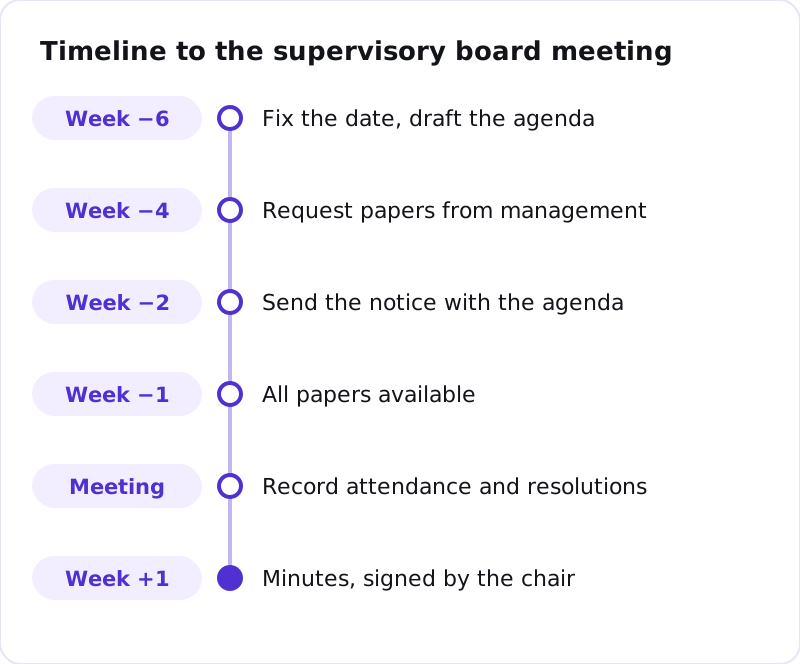
The plan below assumes an ordinary meeting and a board office that supports the chair. Shorten it where your rules allow; never skip a step.
| When | Task | Owner |
|---|---|---|
| Week −6 | Confirm date and format; agree a draft agenda with the chair; list transactions that need consent under § 111 para. 4 AktG | Board office, chair |
| Week −5 | Ask committees what they will prepare and when they meet; book experts or the auditor if needed (§ 109 para. 1 AktG) | Board office, committee chairs |
| Week −4 | Request reports and proposed resolutions from management, with a deadline and a template | Board office |
| Week −3 | Pre-meeting between chair and CEO: agenda, open questions, what is for decision and what for information | Chair, CEO |
| Week −2 | Send the notice with agenda, venue or video link, proposed resolutions, and the deadline for absent members' written votes | Chair, board office |
| Week −1 | All papers available to all members at the same time; check attendance and expected quorum | Board office |
| Meeting day | Confirm attendance and quorum; record resolutions word for word; note who left the room for which item | Chair, minute-taker |
| Week +1 | Draft minutes to the chair; chair signs; action items and resolutions to management | Board office, chair |
Sample proposed resolution
«Proposed resolution, agenda item 4: The supervisory board approves the acquisition of [Muster Logistik GmbH] by the company at a purchase price of up to EUR [amount] on the terms set out in the management board's paper of [date], under § [x] of the rules of procedure for the management board (transactions requiring consent).» A proposal written this way can be voted on as it stands and copied straight into the minutes.
Sample notice email to members
«Dear members of the supervisory board, I hereby call the ordinary meeting of the supervisory board of [Muster AG] on [date] at [time] at [place / video link]. The agenda and the proposed resolutions are attached; the papers will be available in the board portal by [date]. Members who cannot attend can cast a written vote on the proposals through another member (§ 108 para. 3 AktG). Kind regards, [chair]»
What makes the accounts meeting different?
Management must submit the annual accounts, the management report and the proposal on the use of profit without delay once prepared (§ 170 AktG). Every member has the right to see these papers and the audit reports, and they are sent to every member unless the board has resolved to send them only to a committee (§ 170 para. 3 AktG).
Where the accounts must be audited, the auditor must attend the board's or the audit committee's discussion of them and report on the main findings (§ 171 para. 1 AktG). If the auditor is called in as an expert, management does not attend unless the board considers it necessary (§ 109 para. 1 AktG). The board reports in writing to the general meeting on its review and must forward that report to management within one month of receiving the papers; if it misses a further month's deadline, the accounts count as not approved (§ 171 para. 2 and 3 AktG). Plan the meeting date with that clock in mind.
What must the minutes contain?
§ 107 para. 2 AktG sets the minimum: place and date, participants, agenda items, the main content of the discussion and the resolutions. The chair signs. A breach does not invalidate a resolution, but the minutes are the main evidence of what the board knew and how it decided, and every member can ask for a copy.
| Required item | Practical tip |
|---|---|
| Place and date | Record who took part by video or phone |
| Participants | Include guests, experts and management, with the items they attended |
| Agenda items | Number them as in the notice |
| Main content of the discussion | Arguments and the information relied on, not a transcript |
| Resolutions | Exact wording, result, abstentions, and who did not vote because of a conflict |
What changes for GmbHs, co-determined boards and cooperatives?
| Company | What applies |
|---|---|
| Unlisted AG | May resolve to meet once per calendar half-year (§ 110 para. 3 AktG) |
| Co-determined board under the MitbestG | Quorum: at least half of the members it must have (§ 28 MitbestG); simple majority, and on a repeated tie the chair has a second vote (§ 29 MitbestG) |
| GmbH with an optional supervisory board | Only the AktG rules listed in § 52 GmbHG apply, unless the articles say otherwise; that list includes § 110 but not § 107 para. 2 or § 108, so set minutes and resolution rules in the articles or rules of procedure |
| Co-determined GmbH | § 25 MitbestG applies §§ 107 to 116 AktG, among others |
| Cooperative (eG) | The German Cooperatives Act (GenG) governs the supervisory board; with no more than 20 members the articles can do without one (§ 9 GenG) |
Swiss cooperatives work differently again; see our post on the Swiss cooperative's board and ballot. If you support boards in Switzerland too: the Swiss board of directors is a one-tier body, and its minutes are signed by the chair and the minute-taker (Art. 713 para. 3 CO). Our post on one-tier and two-tier boards sets the systems side by side.
What goes wrong most often?
- Papers reach members at different times or in different versions.
- A transaction needing consent is presented «for information», and the resolution is missing.
- The management report on profitability is not on the accounts meeting's agenda.
- Management stays for items where the auditor is called in as an expert, although the board has not found its attendance necessary (§ 109 para. 1 AktG).
- Minutes record «discussed» instead of the resolution's exact wording.
- Action items from the last meeting are not checked at the start of the next one.
In Konsaro, the board office builds the agenda with a type and duration per item, attaches the PDF papers and publishes the meeting when everything is ready; until then it is visible only to the people preparing it. Members can be notified and reminded by email. See meetings and agenda.
Frequently asked questions
How many supervisory board meetings are required each year?
Two per calendar half-year, so four a year (§ 110 para. 3 AktG). In unlisted companies the board can resolve that one meeting per half-year is enough.
What notice period applies?
The AktG sets none. The articles and the rules of procedure decide. Only a meeting requested by a member or management must take place within two weeks of being called (§ 110 para. 1 AktG).
Who signs the minutes?
The chair of the supervisory board (§ 107 para. 2 AktG). Many rules of procedure also require the minute-taker's signature.
Is a resolution void without minutes?
No. § 107 para. 2 AktG states that a breach of the minutes rules does not invalidate a resolution. Without minutes, however, there is no evidence.
Can the management board attend?
§ 109 para. 1 AktG only keeps out people who belong to neither the supervisory board nor the management board. When the auditor attends as an expert, management stays out unless the board considers its attendance necessary.
When does the supervisory board have a quorum?
Unless the law or the articles say otherwise, when at least half of the members it must have take part, and never fewer than three (§ 108 para. 2 AktG). Co-determined boards follow § 28 MitbestG.
Can an absent member still vote?
Yes. Absent members can have written votes handed in by another member, or by a person entitled to attend under § 109 para. 3 AktG (§ 108 para. 3 AktG). A decision without any meeting is a written resolution under § 108 para. 4 AktG.
Sources
- German Stock Corporation Act (AktG), § 90 reports to the supervisory board: gesetze-im-internet.de (German) (checked 29 October 2026)
- AktG, § 107 internal order of the supervisory board (checked 29 October 2026)
- AktG, § 108 resolutions of the supervisory board (checked 29 October 2026)
- AktG, § 109 attendance at meetings (checked 29 October 2026)
- AktG, § 110 calling the supervisory board (checked 29 October 2026)
- AktG, § 111 duties and rights of the supervisory board (checked 29 October 2026)
- AktG, §§ 170, 171 submission and review of the annual accounts (checked 29 October 2026)
- Co-determination Act (MitbestG), §§ 25, 28, 29 (checked 29 October 2026)
- German Cooperatives Act (GenG), § 9 (checked 29 October 2026)
- Limited Liability Companies Act (GmbHG), § 52 supervisory board (checked 29 October 2026)
- AktG, § 116 duty of care of supervisory board members (checked 29 October 2026)
- Swiss Code of Obligations, Art. 713: board resolutions and minutes (checked 29 October 2026)