

Written resolutions of a German supervisory board
—10 min read

A German supervisory board may resolve without a meeting, in writing, by phone or in a comparable form such as email. Unless the articles or the board's rules of procedure provide otherwise, this written resolution (Umlaufbeschluss) is only allowed if no member objects to the procedure (§ 108 para. 4 AktG). The rule covers the board and its committees; quorum and majority follow the general rules.
What does § 108 para. 4 AktG allow?
The provision allows written, telephone or other comparable forms of resolution by the supervisory board and its committees, subject to more detailed rules in the articles or the board's rules of procedure, only if no member objects to the procedure. In practice that means letters, email, conference calls and electronic voting tools. German practice calls the result an Umlaufbeschluss.
Two situations need to be kept apart. Without more detailed rules, every member can stop the procedure by objecting. If the articles or rules of procedure contain a rule, that rule governs; many let the chair order a written procedure and limit the right to object. How far such a limit may go is a legal question for your adviser, especially where it would let the chair override members altogether.
| Route | Legal basis | When it fits |
|---|---|---|
| Meeting in person | § 110 AktG, rules of procedure | Strategy, accounts meeting, anything that needs debate |
| Meeting with an absent member's written vote | § 108 para. 3 AktG | A member cannot attend but the meeting goes ahead |
| Video or phone conference | Rules of procedure; otherwise § 108 para. 4 AktG may apply | Short-notice meetings with real discussion; settle the status in your rules |
| Written resolution (Umlaufbeschluss) | § 108 para. 4 AktG, articles, rules of procedure | Clear yes-or-no decisions between meetings: consent to a transaction, formal approvals |
| Committee resolution | § 107 para. 3 and § 108 para. 4 AktG | Where the matter may be delegated; some tasks cannot be (§ 107 para. 3 AktG) |
Not the same: written votes under § 108 para. 3 AktG
A written resolution differs from written votes by absent members. Under § 108 para. 3 AktG, absent members take part in a meeting by having their written votes handed in by another member, or by a person entitled to attend under § 109 para. 3 AktG. The meeting still takes place; only the vote arrives in writing. Whether a pure video conference counts as a meeting or as a comparable form under § 108 para. 4 AktG is best settled expressly in the rules of procedure.
How does a written resolution work, step by step?
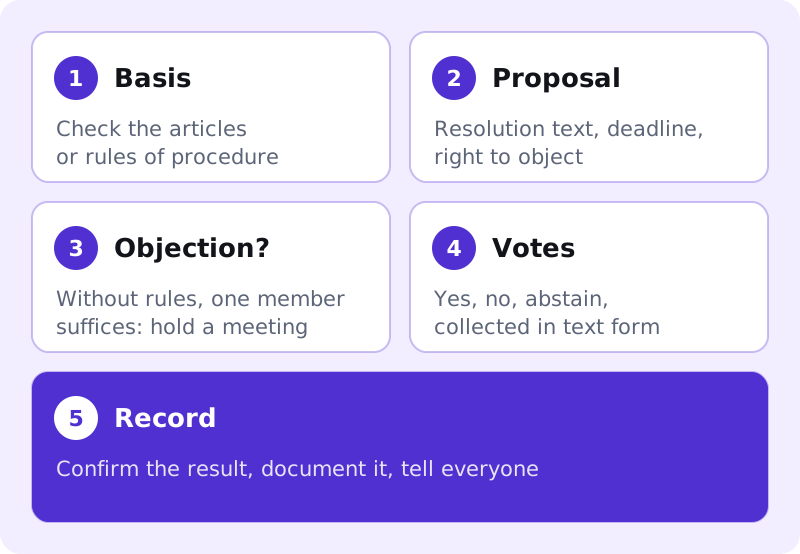
| Step | What happens | Owner |
|---|---|---|
| 1. Check the basis | Read the articles and rules of procedure: who may order the procedure, how objections work, whether committees are covered | Board office |
| 2. Order the procedure | The chair decides to use the written route and approves the proposal text | Chair |
| 3. Send the proposal | To all members at the same time: resolution text, reasons, papers, voting deadline, objection deadline and how to reply | Board office |
| 4. Watch for objections | Without other rules, one objection ends the procedure; tell all members and plan a meeting | Board office, chair |
| 5. Collect votes | Yes, no or abstain in text form; confirm phone votes in writing | Members, board office |
| 6. Confirm the result | Count against quorum and majority; chair signs the record | Chair |
| 7. Inform | Result to all members and to the management board; list it in the next meeting's minutes | Board office |
Sample proposal email
«Dear members of the supervisory board, by order of the chair, the following resolution is to be passed without a meeting under § 108 para. 4 AktG and § [x] of the rules of procedure. Proposed resolution: The supervisory board consents to the lease of the warehouse in [place] as set out in the management board's paper of [date]. Please reply to this email by [date, time] with Yes, No or Abstain. If you object to the written procedure, say so by the same deadline; an objection is not a No vote. Papers: [link]. [Chair]»
Separating the objection from the vote matters. A member who answers «No» has voted; a member who answers «I object» has stopped the procedure. If your email does not make that distinction, you may not know afterwards which one you received.
Which majority and quorum apply?
The general rules apply. Unless the law or the articles say otherwise, the board has a quorum when at least half of the members it must have take part in the resolution, and never fewer than three (§ 108 para. 2 AktG). The majority follows from the articles, the rules of procedure and, where relevant, co-determination law.
In a board under the Co-determination Act, resolutions need a majority of the votes cast; quorum is at least half of the members the board must have (§§ 28, 29 MitbestG). On a tie, a new vote on the same matter gives the chair a second vote if it ties again, and § 108 para. 3 AktG applies to casting that second vote (§ 29 para. 2 MitbestG). In a written procedure, plan for the repeat vote in advance.
The law does not say how to count a member who does not reply at all: did they take part in the resolution or not? That can decide whether there is a quorum. Settle it in the rules of procedure rather than case by case.
Worked example (fictional): the invented «Muster AG» has a supervisory board of six members and no special quorum rule. The chair sends a proposal on Monday with a deadline of Thursday 12:00. Four members vote yes, one votes no, and one does not reply. Nobody objects. Five members took part, more than half of six and more than three, so the board has a quorum, and the proposal passes four to one. Had two members not replied and one of them objected, the written procedure would have ended and a meeting would have been needed. All names in this example are invented.
How should a written resolution be documented?
§ 107 para. 2 AktG requires minutes of meetings; there is no express rule for resolutions without one. A written resolution must still be as provable as a meeting resolution. Record:
- who ordered the procedure and on what basis (articles or rules of procedure);
- the resolution text and papers sent, with date sent and deadline;
- who voted how and when, and any objections;
- whether the quorum was reached, and the confirmed result, signed by the chair;
- the notice to members and to the management board.
Sample record of the result
«Resolution of the supervisory board of [Muster AG] without a meeting under § 108 para. 4 AktG. Ordered by the chair on [date]; deadline [date, time]. Proposal: [text]. Votes: Yes [names], No [names], Abstain [names], no reply [names]. Objections to the procedure: none. Quorum: [x] of [y] members took part. Result: the proposal is adopted. [Place, date, signature of the chair]» Add the record to the minutes of the next meeting so the decisions stay in one place.
What changes for committees, GmbHs and Swiss boards?
§ 108 para. 4 AktG expressly covers committees, so a committee can use the written route under the same conditions. Some tasks cannot be delegated to a committee at all (§ 107 para. 3 AktG); a committee cannot decide those in writing either. For a GmbH with an optional supervisory board, § 52 GmbHG applies only listed AktG rules, and § 108 is not among them; the articles should regulate written resolutions. Our post on rules of procedure for the supervisory board shows where such clauses sit.
| Point | Supervisory board, Germany | Board of directors, Switzerland |
|---|---|---|
| Legal basis | § 108 para. 4 AktG | Art. 713 para. 2 no. 3 CO |
| Forms | Written, telephone or comparable | In writing on paper or electronically; meetings with electronic means are a separate route (no. 2) |
| Who can stop it | Any member by objecting, unless the articles or rules of procedure say otherwise | Any member who asks for an oral debate |
| Other rules | Possible in the articles or rules of procedure | The law names no way to limit the right to a debate |
| Signature | Not regulated | Not needed electronically unless the board has decided otherwise in writing |
| Documentation | No specific rule; treat it like minutes | Minutes required (Art. 713 para. 3 CO) |
If you also work for Swiss boards, our post on circular resolutions of a Swiss board covers that procedure in detail.
Which mistakes should you avoid?
- The proposal sets no deadline for objections, and later nobody knows whether a late «no» was an objection or a vote.
- Not all members get the same papers at the same time.
- Phone approvals are not confirmed in writing.
- The rules of procedure allow written resolutions, but nobody checks whether they also cover committees.
- Non-replies are counted as yes votes.
- The resolution passes but is never documented or passed on to management.
In Konsaro, the chair or the board office starts a circular resolution with a title, the resolution text, the voters and a deadline. The options are yes, no, abstain and request discussion; votes are recorded by name and time, and the decision goes into the decisions register. Whether «request discussion» counts as an objection under § 108 para. 4 AktG is for your rules of procedure to say. See decisions and voting, and our guide to preparing a supervisory board meeting when the written route is closed.
Frequently asked questions
Is a written resolution by email allowed?
Yes. Email is generally treated as a written or comparable form under § 108 para. 4 AktG. Unless the articles or rules of procedure say more, it only works if no member objects to the procedure.
Can the rules of procedure exclude the right to object?
§ 108 para. 4 AktG allows more detailed rules in the articles or rules of procedure. How far they may limit the right to object should be checked by counsel before the clause is adopted.
Does § 108 para. 4 AktG apply to committees?
Yes. The provision expressly names the supervisory board and its committees.
Must a written resolution be signed?
The AktG requires no signature for resolutions without a meeting. It is common and advisable for the chair to sign the confirmed result, as with meeting minutes under § 107 para. 2 AktG.
Does silence count as consent?
Not by law. Whether a member who does not reply took part in the resolution, and so counts for the quorum, is not settled in the AktG; regulate it in the rules of procedure and never count silence as a yes vote.
How is this different from a written vote?
With a written vote under § 108 para. 3 AktG a meeting takes place and an absent member has their vote handed in. With a written resolution under § 108 para. 4 AktG there is no meeting.
Sources
- German Stock Corporation Act (AktG), § 108 resolutions of the supervisory board: gesetze-im-internet.de (German) (checked 29 October 2026)
- AktG, § 107 internal order of the supervisory board (checked 29 October 2026)
- AktG, § 109 attendance at meetings (checked 29 October 2026)
- Co-determination Act (MitbestG), §§ 28, 29 (checked 29 October 2026)
- Limited Liability Companies Act (GmbHG), § 52 (checked 29 October 2026)
- Swiss Code of Obligations (SR 220), Art. 713: board resolutions (unofficial English translation) (checked 29 October 2026)
- AktG, § 110 calling the supervisory board (checked 29 October 2026)