

Circular resolutions for Swiss foundation boards
—9 min read

Whether a Swiss foundation board may decide by circular resolution or in an online meeting is not set out in the Civil Code. The form of management is set by the foundation deed (Art. 83 Civil Code) and detailed in regulations. So check those two documents first. If they say nothing, it is disputed whether the company law rules apply by analogy; in that case, secure your position by amending the regulations.
Why does company law only help so far?
For the board of an AG, Art. 713 para. 2 CO has expressly allowed since 2023 that resolutions are passed at a meeting, by electronic means or in writing; a written resolution is possible only if no member asks for an oral discussion. For foundations there is no such rule. The Civil Code refers to the Code of Obligations for accounting and audit (Art. 83a and 83b), but not for decision-making.
Whether Art. 713 CO applies to foundation boards by analogy when the deed and regulations are silent has not been settled. We treat it as an open question. A clear rule in the regulations saves discussions with the authority or the auditors.
Art. 713 still shows what a careful rule looks like, and you can borrow its three ideas: a resolution may be taken in writing on paper or electronically; no signature is needed for an electronic vote unless the board has written down a different rule; and any member can insist on an oral discussion. The article is for AG boards, so take it as a model, not as the law that governs you.
What have the authorities said about online meetings?
The best source we found is a guide by SwissFoundations, the association of Swiss grant-making foundations, written in March 2020 and updated up to May 2020. It reports an answer from the Federal Office of Justice dated 19 May 2020: virtual meetings of foundation boards are legally permissible as long as the deed does not prohibit them, the chair identifies the participants and the secretary, and the secretary records all deliberations and resolutions clearly. Telephone or video conferences are enough in principle.
The same guide adds practical points. Participants must be able to interact with one another by technology. Sound and picture must be good enough that every statement can be understood and recorded; a dropped connection is a quorum risk. The minutes cannot give one place and time, so they should say the meeting was held by telephone or video conference and where the chair and the secretary were, since those two sign. The guide's wording is from 2020 and refers to the exceptional situation of that time, so it is not certain that it still reflects the Federal Office of Justice's view today. Check your own authority's current guidance.
The guide also notes that circular resolutions «under the general rules» remain available next to virtual meetings. Those general rules are exactly the point: the deed and the regulations.
Which clauses belong in the regulations?
| Point | Possible rule (example, not binding) |
|---|---|
| Circular resolution | Resolutions may be passed in writing on paper or electronically unless a member asks for a meeting within the deadline. |
| Majority | Circular resolutions require a majority of all members, not only of those voting. |
| Deadline | The voting deadline is at least five working days, shorter in urgent cases. |
| Form of vote | A vote by e-mail or in a board portal that can be attributed to the person also counts as written. |
| Online meeting | Meetings can be held wholly or partly by electronic means if all participants can hear each other and speak. |
| Minutes | Circular resolutions are entered in the minutes of the next meeting. |
The examples show options, not template wording. Have changes to the regulations checked by a specialist and find out whether your supervisory authority must be informed. Changes to the deed itself are only possible through the authorities (Art. 85 to 86b Civil Code).
Majority of all members, or unanimity?
This is the choice that matters most, and the two usual answers behave differently. Requiring a majority of all members means that silence counts like a «no»: a board of five needs three yes votes however many members reply. Requiring unanimity gives each member a veto, and one slow reply stalls the decision. Many grant boards use a majority of all members for ordinary grants and a meeting for anything larger. Whichever you choose, write down what a non-reply means. Silence should not count as consent.
| Option | Works well when | Watch out for |
|---|---|---|
| Majority of all members | Routine grants, approvals of minutes, budget lines already agreed | Needs enough replies; set a deadline and a reminder |
| Majority of votes cast | Large boards where abstentions are normal | Can pass with very few votes; add a minimum number of votes |
| Unanimity | Small boards, sensitive topics, changes to regulations | One slow member blocks; add a fall-back to a meeting |
| Not allowed | Foundations whose deed forbids it | Use online meetings instead, if the deed allows them |
Sample wording
The following is invented wording for illustration (Muster Stiftung). It is not legal advice and has not been reviewed by a lawyer.
| Clause | Wording |
|---|---|
| Written resolutions | Resolutions of the foundation board may be passed by circular resolution, on paper or electronically, unless a member requests an oral discussion in writing within the deadline set. |
| Quorum and majority | A circular resolution is passed if a majority of all members vote in favour in time. Members who do not reply are counted as not having voted in favour. |
| Right to discuss | If a member asks for a discussion within the deadline, the circular procedure ends and the item is placed on the agenda of the next meeting or of an online meeting. |
| Recording | The secretary records the question, the deadline, each vote with date and time, and the result, and enters them in the minutes of the next meeting. |
How does a clean circular resolution work?
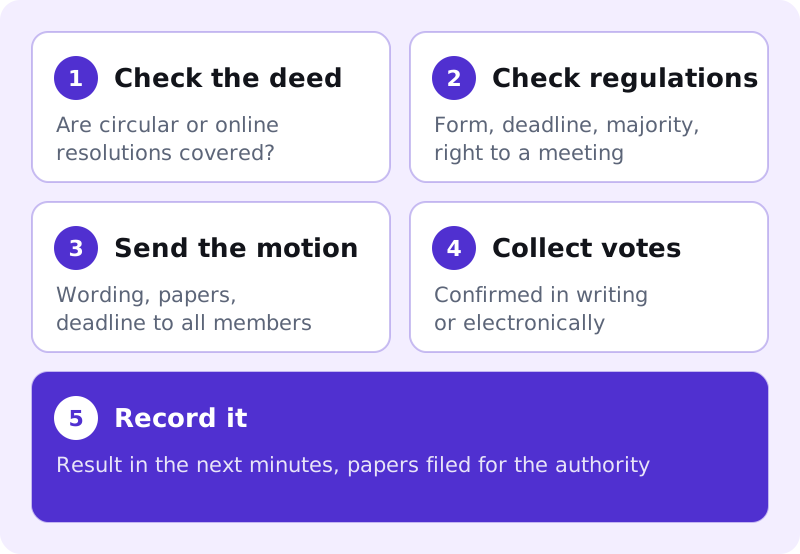
- Word the motion so that it can be answered yes or no.
- Attach all papers needed for the decision, for example the application and the review by the foundation's office.
- Set a clear deadline and say how a member can ask for a meeting.
- Record every vote with its date.
- Tell all members the result and enter it in the next minutes.
| Step | Owner | Output |
|---|---|---|
| Draft the motion and attach papers | Secretary or foundation office, approved by the chair | One-page motion and attachments |
| Send with deadline | Secretary | Message to all members with the reply route |
| Answer questions | Chair | Replies shared with all members, not one by one |
| Collect votes | Secretary | Register of votes with date and name |
| Close and inform | Secretary | Result message; entry in next minutes |
A reply to one member's question should reach all members. If one member gets information the others do not, the vote is easier to question later.
Worked example
Muster Stiftung has a board of five. Its regulations allow circular resolutions by majority of all members and give each member the right to ask for a discussion. In October the foundation office receives a small application for CHF 5,000. The secretary drafts the motion, attaches the application and the office's review, and sends both to the five members on Monday with a deadline of the following Monday. Three members vote yes on Tuesday and Wednesday. Nobody asks for a discussion. The secretary closes the item on Monday, tells the members, and the result is entered in the minutes of the December meeting with the dates of each vote. If a fourth member had asked for a discussion, the item would have gone to the next meeting.
When should the foundation board meet anyway?
- for large grants or investment decisions,
- when a member has questions or concerns,
- for conflicts of interest, because the recusal must be discussed,
- for decisions that must be reported to the authority, for example under Art. 84a Civil Code,
- for the annual accounts and the report to the authority.
An online meeting is often the better middle way: quick to organise, but with a real discussion. Make sure every member can take part technically and that attendance is recorded in the minutes. More on attendance in the post on late arrivals and quorum.
What about conflicts of interest in a written vote?
A member who has a conflict cannot leave the room in a circular resolution, so the rule needs to say what happens instead. A workable approach: the member discloses the conflict to the chair when the motion arrives, does not vote, and the minutes record this. Decide in the regulations whether the quorum counts all members or only those who can vote. See conflicts of interest on a board for graded measures.
How does Konsaro help foundation boards with this?
In Konsaro you set up a circular resolution with title, text, voters and deadline. Members vote yes, no, abstain or request a discussion. Votes are recorded by name, and the result is approved, rejected or deferred. For online meetings you add the link to Teams, Zoom, Webex or Meet. See decisions and voting and meetings and agenda.
Frequently asked questions
May a foundation board decide by circular resolution without a rule in the deed?
That is not settled. The Civil Code does not regulate it, and whether Art. 713 CO applies by analogy is open. Create a clear basis in the regulations.
Is an e-mail enough as a vote?
Yes, if the regulations allow it and the vote can be clearly attributed to a person. Put the rule in writing.
Must the authority be told about circular resolutions?
The Civil Code does not require it one by one; check your authority's guidance. Document the resolutions so they can be followed, because the authority can ask for papers.
Are online meetings allowed for foundation boards?
According to the Federal Office of Justice's position reported by SwissFoundations in May 2020, yes, if the deed does not prohibit them, the chair identifies the participants and the secretary records everything clearly. Check your deed and your authority's current guidance.
Can one member block a circular resolution?
Yes, if the regulations give each member a right to an oral discussion or require unanimity. Without such a rule it depends on whether Art. 713 CO applies by analogy, which is open. A right to ask for a discussion is sensible and mirrors company law.
Does silence count as consent?
No. Say in the regulations that a member who does not reply has not voted in favour. Under a «majority of all members» rule that has the same effect as a no.
Which majority is safest for a circular resolution?
A majority of all members is the simplest safe choice for ordinary decisions. Use a meeting for large or contested ones.
Sources
- Swiss Civil Code (SR 210), Art. 83: organisation of the foundation (German text) (checked 29 October 2026)
- Swiss Civil Code (SR 210), Art. 83a and 83b: accounting, auditors (German text) (checked 29 October 2026)
- Swiss Civil Code (SR 210), Art. 84a: over-indebtedness (German text) (checked 29 October 2026)
- Swiss Civil Code (SR 210), Art. 85, 86, 86a and 86b: changes (German text) (checked 29 October 2026)
- Swiss Code of Obligations (SR 220), Art. 713: board resolutions (German text) (checked 29 October 2026)
- SwissFoundations, Governance in Krisenzeiten (March 2020, updated to May 2020), with the Federal Office of Justice's answer of 19 May 2020 (German) (checked 29 October 2026)