

Swiss board minutes: content, signatures, retention
—13 min read
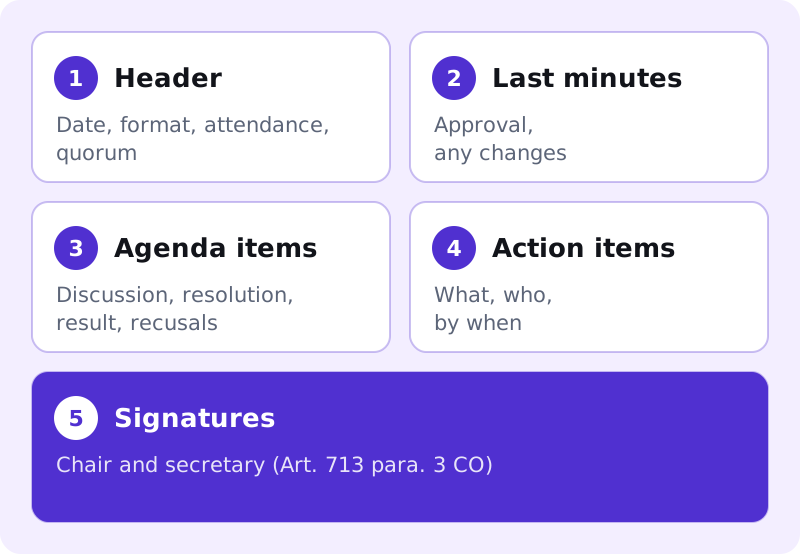
Swiss law requires minutes of the board's deliberations and resolutions, signed by the chair and the minute-taker (Art. 713 para. 3 CO). The Code of Obligations says nothing more about content. Attendance, voting results, dissent and recusals come from the organisational regulations, liability considerations and good practice.
What exactly does Art. 713 para. 3 CO require?
The rule is one sentence: minutes must be kept of the deliberations and resolutions, and they are signed by the chair and the minute-taker. That gives three duties. Every meeting needs minutes. They must cover the deliberations, not only the resolutions. And they need two signatures: the person chairing and the person taking the minutes.
The law does not say how detailed the deliberations must be. A verbatim record is not required. But the minutes should show which arguments and information the decision rested on. For difficult items, that is later the evidence that the board decided with due care.
What does one minute entry look like?
Abstract advice only goes so far, so here is one agenda item from a fictional Muster AG (invented for illustration). It shows the order that makes a minute entry easy to check later: basis, discussion, conflict, resolution, follow-up.
| Part | Sample wording |
|---|---|
| Basis | Item 4: Lease for the new office premises. The board had paper 4.1 (cover sheet) and paper 4.2 (draft lease), sent to all members with the invitation. |
| Discussion | The CFO explained the rent and the term. The chair asked whether other sites had been compared; the CFO named two and said why they were dropped. Ms Berger asked about the early-termination clause; the legal counsel confirmed it and said where it sits in the draft. |
| Conflict | Mr Conti disclosed that a company of his family owns a share in the landlord. He left the room for the discussion and the vote. |
| Resolution | The board resolves to sign the lease as in paper 4.2 and authorises the CEO and the CFO to sign jointly. Result: 4 yes, 0 no, 0 abstentions. Mr Conti did not take part. |
| Follow-up | CFO: sign the lease and report to the next meeting. |
Notice what is missing: no sentence-by-sentence account, no adjectives, no side remarks. Notice what is there: the papers the board relied on, the questions that mattered and who answered, and the exact resolution that can be copied into an implementation note or a commercial register filing. For two more levels of detail see how detailed board minutes should be.
What do good Swiss board minutes contain?
The legal minimum is quickly met. Minutes that still answer questions years later contain more. The table separates what the law requires from what has proven useful in practice.
| Element | Required by law? | Why record it |
|---|---|---|
| Resolutions in full wording | Yes, Art. 713 para. 3 CO | Core of the minutes; basis for implementation and the commercial register |
| Main points of discussion | Yes, Art. 713 para. 3 CO | Shows what the decision was based on |
| Signatures of chair and minute-taker | Yes, Art. 713 para. 3 CO | Confirms accuracy |
| Date, venue or format, start and end | Not expressly | Identifies the meeting |
| Present, excused, guests | Not expressly | Shows the quorum under the regulations was met |
| Voting result | Not expressly | Shows the majority under Art. 713 para. 1 CO was reached |
| Dissenting views | Not expressly | Can matter to the individual member in a liability question |
| Conflicts of interest and recusals | Disclosure is required (Art. 717a CO); recording it is practice | Shows the conflict was disclosed and handled |
| Action items with owner and due date | No | Makes follow-up checkable |
Verbatim minutes or resolution minutes?
Swiss boards mostly use extended resolution minutes: a short summary of the discussion for each item, then the resolution in full and the result. Verbatim minutes take a lot of work, are hard to read and record thinking aloud that never mattered for the decision. Pure resolution minutes without any discussion, on the other hand, hardly meet the legal duty, because Art. 713 para. 3 CO expressly mentions the deliberations.
A good rule of thumb: record which papers were available, which key questions were asked and how they were answered, which alternatives were considered and which concerns were raised. Name people where it matters for understanding or for an individual member's responsibility.
Must a dissenting vote be minuted?
The law does not say so expressly. In practice it is common, and sensible, to let a member have their vote against and the reasons recorded on request. The reason is liability: board members are liable for damage they cause by intentional or negligent breach of their duties (Art. 754 para. 1 CO). A member who voted against a resolution can show it with the minutes. Whether and how much that affects personal liability depends on the specific case.
Write into the organisational regulations that any member may ask for their vote and a short reason to be recorded. Then nobody has to negotiate it in the meeting.
How do you minute a conflict of interest or a recusal?
Members of the board and of management must inform the board immediately and fully about conflicts of interest that concern them, and the board takes the measures needed to protect the company (Art. 717a CO). The article does not say that the member must leave the room. Many organisational regulations do, and the minutes should then show what happened: who disclosed what, whether the member took part in the discussion, whether they left for the vote, and what the board decided to do.
- Record the disclosure in neutral words: who, and the fact that creates the conflict.
- Record the measure the board chose: recusal from the discussion, from the vote, or both; or a decision that no measure was needed, with the reason.
- Record the times the member left and came back if they were out for a part of the item.
- Record the vote without the recused member, so the majority can be checked against the members who actually voted.
A short line is enough: "Mr Conti disclosed that [fact]. He did not take part in the discussion or the vote." If a conflict is discovered after the fact, the minutes of the next meeting are where it is disclosed and the board's response is recorded.
How are circular resolutions and video meetings minuted?
The board can pass resolutions in three ways: at a meeting with a venue, using electronic means (applying Art. 701c to 701e CO by analogy), or in writing on paper or electronically unless a member demands oral deliberation (Art. 713 para. 2 CO). Each route leaves different traces, and the minutes should say which route was used.
| Route | What the record should show |
|---|---|
| Meeting at a venue | Date, place, attendance, deliberations, resolution, result, signatures of chair and minute-taker |
| Electronic meeting (video or telephone) | The same, plus the format used and that the identity of the participants was established. Art. 701e CO, applied by analogy, expects identity, immediate transmission of statements, the right to speak and move, and a vote that cannot be falsified |
| Written or electronic circular resolution | The resolution text, who was asked, how each member voted and when, the date it took effect. No signature is needed for an electronic resolution unless the board has set otherwise in writing (Art. 713 para. 2 no. 3 CO) |
Para. 3 speaks of deliberations and resolutions in general. Whether a circular resolution without any meeting needs minutes in the sense of para. 3 is not stated expressly. The practical answer is to keep the resolution as a document with the voting record, and to list it as a "for information" item at the next meeting so the minute book is complete. The circular route is covered in the post on circular resolutions.
How do board minutes differ from general meeting minutes?
The two are often confused. The general meeting minutes have a content list written into the statute: Art. 702 para. 2 CO names date, start and end, form and place, the shares represented, resolutions and election results, information requests and answers, statements given for the minutes, and relevant technical problems. The board minutes have no such list.
| Question | Board minutes | General meeting minutes |
|---|---|---|
| Content set by law | Deliberations and resolutions only (Art. 713 para. 3) | Six listed items (Art. 702 para. 2) |
| Signatories | Chair and minute-taker | Minute-taker and chair of the meeting (Art. 702 para. 3) |
| Who may see them | Members, via their right to information (Art. 715a) | Every shareholder may ask for the minutes to be made accessible within 30 days of the meeting (Art. 702 para. 4) |
| Who is responsible | The board, as part of its organisation | The board sees to it that minutes are kept (Art. 702 para. 2) |
What should the organisational regulations add?
Because the law is silent on most points, the regulations carry the rest. Boards that settle these questions once spend less time on them in each meeting.
- Who is minute-taker, and who stands in.
- The level of detail: resolution minutes with a summary of the discussion, or something else.
- Each member's right to have their vote and a short reason recorded.
- The deadline for the draft and for comments, and how approval works.
- How a signed record is corrected.
- Retention period and place of safekeeping.
- Who outside the board may read the minutes and under which confidentiality terms.
Approval is covered in approving board minutes, and the wider contents of the regulations in the organisational regulations post.
What makes board minutes weak?
- Minutes that list only resolutions, with no trace of what the board considered.
- Minutes written weeks later from memory, so the details are gone.
- Resolution wording that differs from what was voted on, because it was tidied up afterwards.
- No vote count, so nobody can tell later whether the majority was reached.
- Conflicts disclosed in the meeting but missing from the record.
- Papers not named, so the information basis cannot be reconstructed. Refer to the paper numbers.
- A signed version that was later edited without a note. Correct a signed record by a noted amendment at the next meeting; do not silently replace it.
- Verbatim notes of every remark, which bury the decision and say more about individuals than the board intended.
Who signs, and can it be done electronically?
The person chairing the meeting and the minute-taker must sign (Art. 713 para. 3 CO). The other members do not sign; they usually approve the minutes at the next meeting. The law does not require the minute-taker to be a board member; often a board secretary, a lawyer or a member of management takes the minutes.
Electronic signing is possible. Under Art. 14 para. 2bis CO, a qualified electronic signature with a qualified time stamp equals a handwritten signature. Whether a simpler electronic form is enough for board minutes is not answered expressly. For circular resolutions passed electronically, the legislator dropped the signature requirement in so many words; for the minutes, it did not. To be on the safe side, sign the minutes by hand or with a qualified signature, and have the question assessed for your company.
How long must board minutes be kept?
The Code of Obligations sets no retention period specifically for board minutes. Art. 958f para. 1 CO requires the accounting records, vouchers, annual report and audit report to be kept for ten years. Whether board minutes fall under this is not expressly settled. Because minutes evidence decisions on the accounts, contracts and officers, and liability claims can become time-barred as late as ten years after the harmful conduct, or later where it was a criminal offence (Art. 760 CO), most companies keep board minutes for at least ten years, many permanently.
How do minutes get from draft to approval?
- Draft within a few days of the meeting, while memories are fresh.
- Review by the chair, with questions to individual members if needed.
- Circulate to all members with a deadline for corrections.
- Approval as a standing item at the next meeting; any changes are minuted there.
- Signature by chair and minute-taker, then filing in the minute book.
Action items should not wait for approval. Send them to their owners right after the meeting. How they otherwise drift between meetings is covered in our post on action-item drift after meetings; why the minutes are the control point for the right version of the papers is in minutes as the control point.
How does software support board minutes?
In Konsaro, the minutes record attendance (present, excused, absent or remote), meeting roles, and decisions and action items per agenda item. The draft has comments and a version history, the board office can share it with selected people for review before publishing, and the final minutes export as PDF. The signature itself happens outside Konsaro, by hand or with a qualified electronic signature. See minutes and follow-up.
Frequently asked questions
Must all board members sign the minutes?
No. Art. 713 para. 3 CO requires the signatures of the chair and the minute-taker. The other members usually approve the minutes at the next meeting.
Does the minute-taker have to be a board member?
No, the law does not require it. Board minutes are often kept by a board secretary, an external specialist or a member of management, who should be bound to confidentiality.
May the meeting be recorded to write the minutes?
The CO does not regulate recordings. Get the participants' consent, decide who has access, and delete the recording once the minutes are approved, unless the board decides otherwise.
What about circular resolutions?
They need to be documented too, usually in the minutes of the next meeting or in a resolution log. A resolution passed electronically needs no signature unless the board has set otherwise in writing (Art. 713 para. 2 no. 3 CO).
Can shareholders see the board minutes?
The CO gives shareholders no general right to inspect board minutes. Shareholders have information and inspection rights under Art. 697 ff. CO, assessed case by case. General meeting minutes are different: every shareholder may ask for the minutes to be made accessible within 30 days of the meeting (Art. 702 para. 4 CO).
When must the minutes be ready?
The law sets no deadline. A draft within a few working days and approval at the next meeting has proven practical.
Can minutes be corrected after they are signed?
The law does not regulate it. Good practice is to leave the signed text as it is, record the correction as a decision at the next meeting and attach it to the original. The chair and the minute-taker then sign the correction too.
Does a member who was absent get the minutes?
Yes, in practice every member receives them. Each member can ask for information about all matters of the company (Art. 715a para. 1 CO), and an absent member remains responsible for the board's business, so they need the minutes to follow it.
Do committees need their own minutes?
Art. 713 para. 3 CO speaks of the board. Where the board assigns preparation or oversight to committees (Art. 716a para. 2 CO), keep short minutes of the committee's meetings as well, and report to the full board. The regulations should say so.
Sources
- Swiss Code of Obligations (SR 220), Art. 713 para. 3: board minutes (German text) (checked 29 October 2026)
- Swiss Code of Obligations (SR 220), Art. 14 para. 2bis: qualified electronic signature (German text) (checked 29 October 2026)
- Swiss Code of Obligations (SR 220), Art. 958f: retention of accounting records (German text) (checked 29 October 2026)
- Swiss Code of Obligations (SR 220), Art. 754 and 760: liability and limitation (German text) (checked 29 October 2026)
- Swiss Code of Obligations (SR 220), Art. 697 and 702: shareholders' information rights, general meeting minutes (German text) (checked 29 October 2026)
- Swiss Code of Obligations (SR 220), Art. 713 para. 2 and Art. 701c–701e: ways of passing resolutions and electronic means (German text) (checked 29 October 2026)
- Swiss Code of Obligations (SR 220), Art. 717a: conflicts of interest (German text) (checked 29 October 2026)
- Swiss Code of Obligations (SR 220), Art. 715a and 716a para. 2: right to information, committees (German text) (checked 29 October 2026)