

Circular resolutions of a Swiss board: rules and process
—10 min read

A Swiss board of directors may pass resolutions in writing, on paper or electronically, as long as no member asks for an oral discussion (Art. 713 para. 2 no. 3 CO). Since 1 January 2023, a circular resolution passed electronically needs no signature, unless the board has decided otherwise in writing. The majority of votes cast decides; the chair has the casting vote unless the articles say otherwise.
What does Swiss law say about circular resolutions?
Art. 713 para. 2 of the Swiss Code of Obligations (CO) lists three ways a board can decide: at a meeting with a physical venue, by electronic means (applying Arts. 701c to 701e CO on virtual general meetings by analogy), and in writing on paper or in electronic form. The third way is the circular resolution, known in German as Zirkularbeschluss or Zirkulationsbeschluss. We read the article on fedlex on 29 October 2026 (version in force from 1 October 2026).
Two rules apply to the written route. First, it is only allowed if no member requests oral deliberation, so one member is enough to pull the matter into a meeting. Second, for a resolution passed electronically no signature is required, unless the board has laid down something else in writing. For the majority, the law relies on Art. 713 para. 1 CO: resolutions pass with the majority of votes cast, and the chair has the casting vote unless the articles of association provide otherwise.
What the article does not say matters as much. It sets no deadline, no minimum number of participants and no rule for members who do not reply. Those gaps are yours to fill in the organisational regulations, see the organisational regulations post.
What changed with the 2023 company law reform?
Before the reform, the law spoke of written consent to a proposal. In practice that usually meant printing the proposal, signing it and sending it back or scanning it. Since 1 January 2023, the Code names the electronic form explicitly and states that no signature is required for it. A board can now vote by email or in software without every member needing a qualified electronic signature.
Mind the exception: the board can decide in writing that electronic circular resolutions must still be signed. Check your organisational regulations and earlier board decisions before you change the process. Many older regulations still require a signature explicitly. For when a qualified signature is still needed, for example for the commercial register, see circular resolutions with Skribble or DocuSign.
When does a circular resolution make sense?
A circular resolution saves a meeting. It does not replace a discussion. As a rule of thumb: the clearer the facts and the less there is to debate, the better the written route fits.
| Situation | Circular resolution? | Why |
|---|---|---|
| Formal decisions, such as changing signing authorities | Good fit | Clear facts, little to discuss |
| Approving a matter already discussed at the last meeting | Good fit | The deliberation has already happened |
| Urgent decisions between two meetings | Fits, with a short deadline | Faster than an extraordinary meeting; see urgent board decisions |
| Strategic or contested questions | Poor fit | Needs discussion; a member will likely ask for a meeting anyway |
| Matters where a member has a conflict of interest | Only with disclosure and the board's measures clearly recorded | The member must disclose the conflict (Art. 717a para. 1 CO); the board decides on measures such as recusal (para. 2), and both should be traceable |
| Duties the board cannot delegate (Art. 716a CO), such as the annual report or the notification of the court in case of over-indebtedness | Possible in form, but think twice | The board remains responsible; a short written vote on a complex matter invites later disputes |
How does a circular resolution work, step by step?
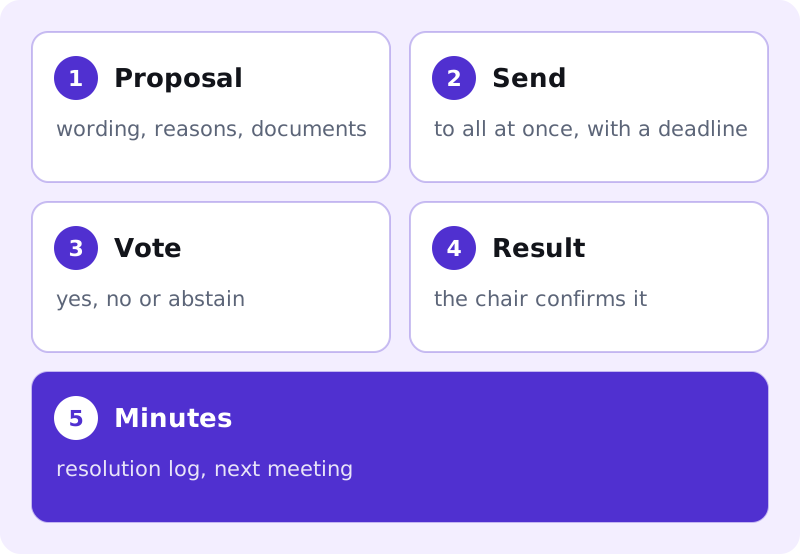
- Draft the proposal: resolution wording that stands on its own without a cover email, with the reasoning and the documents needed.
- Send it: to all members at the same time, with a clear reply deadline and a note that any member may ask for an oral discussion.
- Vote: yes, no or abstain, in writing on paper or electronically. A member who asks for a discussion stops the written route.
- Confirm the result: after the deadline, the chair confirms whether the proposal passed and tells all members.
- Record it: the proposal, the votes and the result go into the minutes of the next meeting or the resolution log.
Who does what is worth writing down once:
| Step | Owner | Output |
|---|---|---|
| Draft the motion | The member or manager who requests the decision, with the board secretary | Resolution text and attachments |
| Send and set the deadline | Chair or board secretary | One message to all members, same time, same documents |
| Answer | Each member | Yes, no, abstain, or the request for oral deliberation |
| Declare the result | Chair | Written confirmation to all members |
| Record | Board secretary / minute taker | Entry in the resolution log and the next minutes |
Which majority applies, and what about members who do not reply?
The law points to the majority of votes cast and the chair's casting vote (Art. 713 para. 1 CO). Members who do not reply cast no vote, but the law does not say whether the resolution is then valid with fewer participants. That gap causes the same kind of uncertainty as quorum questions in meetings. Set it out in your organisational regulations: how many members must take part at minimum, whether abstentions count, and what happens when someone does not reply. Many boards require every member to respond to a circular resolution, or set a minimum quorum.
Worked example with the invented Muster AG: five board members, a regulation that at least four must reply. Three vote yes, one abstains, one does not reply by the deadline. Four have taken part, so the quorum in the regulation is met; with three yes votes, the proposal passes whether or not the abstention counts as a vote cast (three of three, or three of four). If the regulation had been silent, the board would have an avoidable dispute about validity. That is why the rule belongs in writing before the first circular resolution.
What if a member asks for an oral discussion?
The written route ends for that proposal. The chair puts it on the agenda of the next meeting or calls a short one, in person or by electronic means. Record the request, the date and who made it; do not count votes already received as a decision. Whether votes already cast stay valid if the discussion changes the proposal is not settled by the article, so the safe course is to vote again on the final text.
What belongs in the minutes?
The board must keep minutes of its deliberations and resolutions, signed by the chair and the person keeping them (Art. 713 para. 3 CO). For circular resolutions, a good practice is to list them in the minutes of the next meeting or keep a running resolution log. Record at least: the wording of the proposal, the date sent and the deadline, who voted how, whether anyone asked for a discussion, the result, and any recusals. More in the post on minutes under the CO.
Sample entry, for the invented Muster AG: "Circular resolution no. 4/2026. Proposal sent on 3 March 2026, deadline 10 March 2026, 12:00. Yes: A. Muster, B. Beispiel, C. Probe. Abstain: D. Test. No reply: E. Demo. No member requested oral deliberation. The proposal is approved. Confirmed by the chair on 10 March 2026."
When resolutions, votes and action items sit in one place, nobody has to rebuild the minutes from an inbox. The page on minutes and follow-up shows how that looks in a board portal.
Paper, email or board portal?
| Criterion | Paper | Board portal | |
|---|---|---|---|
| Signature | Usual, handwritten | Not needed since 2023 unless required internally | Not needed since 2023 unless required internally |
| Tracking the deadline | Manual | Manual, through replies in the inbox | Deadline and open votes visible |
| Right to an oral discussion | Must be stated in the cover letter | Must be stated in the email | Can be its own answer option |
| Traceability | File the originals | Collect and archive the emails | Votes and result in the audit trail |
| Effort for the secretariat | High | Medium | Low |
Email works for small boards. You then have to make sure yourself that every member receives the same proposal, that replies are unambiguous and that everything is archived completely.
What goes wrong most often?
- The proposal is a question in an email rather than resolution wording. Later, nobody is sure what exactly was decided.
- There is no deadline, or it moves while the vote is running.
- Members do not receive the proposal at the same time or with the same documents.
- The note about the right to ask for an oral discussion is missing.
- The result is not shared with everyone and never appears in the next minutes.
- The regulations still require a signature, but the board only votes by email.
- A member with a conflict of interest votes without it being recorded.
How does a board portal support circular resolutions?
In Konsaro, the chair or the board office creates the circular resolution with a title, the resolution text, the voters (all active members by default) and a deadline. Members vote yes, no, abstain or request discussion, every vote is recorded by name and time, and the result lands in the decisions register with an audit trail of who did what and when. See decisions and voting and the overview for the corporate secretary. For the template, see the circular resolution template; for the member's side, voting by circular resolution; for software options, circular resolution software compared.
Frequently asked questions
Does a circular resolution have to be unanimous?
No. The majority of votes cast decides (Art. 713 para. 1 CO); a stricter rule can only come from your own articles or regulations, so check them. Only the waiver of an oral discussion must be unanimous in effect: if any member asks for a meeting, the written route is closed.
Is a circular resolution by email valid?
Yes. Since 1 January 2023, Art. 713 para. 2 no. 3 CO explicitly allows the electronic form, and no signature is required. The exception is a written board decision that electronic resolutions must still be signed.
Who can block a circular resolution?
Any single member, by asking for an oral discussion. The proposal must then be dealt with at a meeting, in person or by electronic means.
How long should the reply deadline be?
The law sets no deadline. A few working days is common, shorter for urgent matters. What matters is that the deadline is stated in the proposal and applies to everyone equally.
Does this apply to executive boards or foundation boards?
Art. 713 CO governs the board of directors of a Swiss company limited by shares (AG). For executive boards, foundation boards or association committees, check their own articles, regulations and statutory rules for whether and how circular resolutions are allowed. For foundations see circular resolutions for foundation boards.
Can a resolution for the commercial register be passed by circulation?
The board can decide by circulation. But for an electronic filing, the exhibits need a qualified electronic signature with a qualified time stamp (Art. 20 para. 2 Commercial Register Ordinance). Ask your register office or lawyer how they want the resolution documented.
Do abstentions and non-replies count as votes cast?
The law does not say. Settle it in the regulations, for example that abstentions count as participation but not as votes cast, and that a minimum number of members must reply.
Sources
- Swiss Code of Obligations (SR 220), Art. 701c-701e, 713, 716a and 717a: fedlex.admin.ch (checked 29 October 2026)
- Commercial Register Ordinance (SR 221.411), Art. 18 and 20: fedlex.admin.ch (checked 29 October 2026)