

Circular resolution template for Swiss boards of directors
—9 min read

A circular resolution template needs three documents: the motion, with the exact resolution wording, reasons, deadline and a note on the right to ask for oral deliberation; a voting form with yes, no, abstain and an “oral deliberation requested” box; and a result sheet for the minutes. The legal basis is Art. 713 para. 2 no. 3 CO.
What goes into the motion?
The motion is the one document that goes to all members at the same time. It replaces the discussion in the meeting, so it has to contain everything a member needs to decide.
| Field | Content | Why |
|---|---|---|
| Company, body, no. | Company name, board of directors, running number of the circular resolution | Links the motion to the minutes and the decisions register |
| Sent on, on behalf of | Date; board office on behalf of the chair | Proves that everyone was informed at the same time |
| Resolution wording | “The Board of Directors approves …” in full | Members vote on this text, not on a question |
| Reasons | Why the resolution is needed and why in writing | Takes the place of the discussion |
| Documents | Title and page count of each attachment | Everyone votes on the same version |
| Deadline | Date and time | The law sets none; your organisational regulations may |
| Required majority | As set in the articles or regulations | Otherwise the majority of votes cast applies (Art. 713 para. 1 CO) |
| Right to oral deliberation | Any member may ask for it | Art. 713 para. 2 no. 3 CO |
| Conflicts of interest | Request to disclose them on the voting form | Art. 717a CO |
Write the resolution as a sentence that stands on its own: “The Board of Directors grants [name] joint signature authority with one other signatory with effect from [date] and instructs the board office to file the change with the commercial register.” Someone reading it in ten years, without the email it came with, must still know what was decided.
How is the motion filled in? A worked example
The example is invented: Muster AG is a fictional company, and all names, dates and amounts are made up.
| Field | Entry |
|---|---|
| Resolution | “The Board of Directors approves the lease extension for the Zurich office until 31 December 2031 on the terms of paper A and authorises the CFO to sign.” |
| Reasons | The landlord needs an answer by 20 November. The terms are unchanged from the discussion at the September meeting, apart from the extension to 2031 as set out in the one-page summary. |
| Documents | A: draft lease extension (6 pages); B: one-page summary (1 page) |
| Sent | 10 November 2026, 09:00, by the board office on behalf of the chair |
| Deadline | 17 November 2026, 17:00 |
| Majority | Majority of votes cast, as in the organisational regulations |
| If no reply | A member who has not replied by the deadline is not counted as voting (rule from the organisational regulations of Muster AG) |
The last row matters more than it looks. Art. 713 CO does not say how to treat members who do not answer, and it does not set a minimum number of replies. Whatever your board chooses, put it in the motion so nobody has to guess afterwards.
What does the voting form look like?
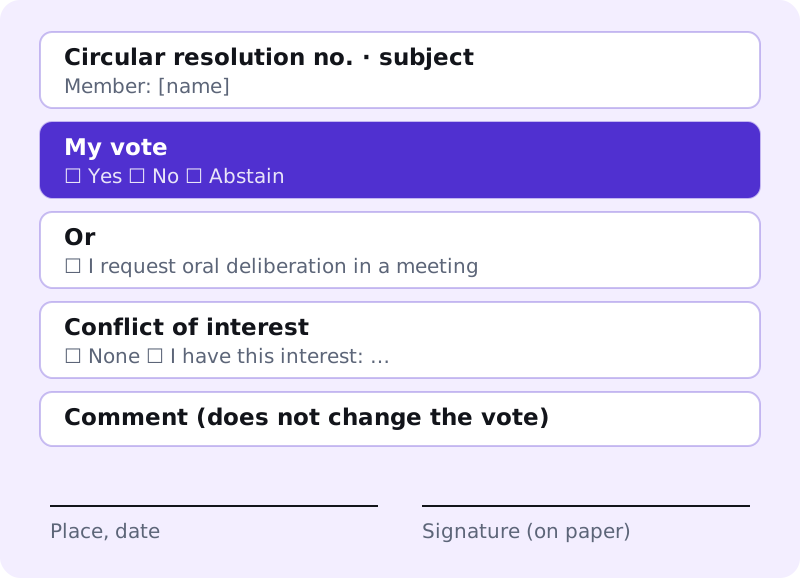
- Number and subject of the circular resolution, name of the member.
- A line saying the vote is on the motion as sent, unchanged.
- My vote: yes, no, abstain.
- Or: I ask for oral deliberation at a meeting (Art. 713 para. 2 no. 3 CO).
- Conflict of interest: none, or a description of the interest.
- Comment (optional; a comment does not change the vote).
- Place, date, signature. For an electronic vote no signature is needed unless the board has decided otherwise in writing (Art. 713 para. 2 no. 3 CO).
A “yes, but” does not belong in the comment box. A member who wants a change asks for oral deliberation, or calls the chair before the deadline. Otherwise it is unclear later what the member actually voted for.
What does the result sheet record?
When the deadline has passed, the chair establishes the result and tells all members. The result sheet documents:
- Number, subject, date sent and deadline.
- How many members could vote, and who did not because of a conflict of interest.
- Whether anyone asked for oral deliberation. If so, the motion goes to the next meeting and there is no result.
- For each member: reply received on, by which channel, vote.
- Result: approved, rejected or not reached.
- The resolution as approved, and the minutes in which it will be recorded.
- Signature of the chair and the board office.
| Member | Reply received | Channel | Vote |
|---|---|---|---|
| Chair | 11 Nov, 08:12 | Portal | Yes |
| Member A | 11 Nov, 14:40 | Yes | |
| Member B | 12 Nov, 09:05 | Portal | Abstain |
| Member C | 16 Nov, 16:30 | Portal | Yes |
| Member D | — | — | No reply by the deadline |
Result: approved, three yes, one abstention, one member without a reply. Whether that is enough depends on the majority your regulations require and on how they treat silence, which is why the motion states both.
How is a circular resolution recorded in the minutes?
The usual route is a standing item at the next meeting that lists every circular resolution since the last one, with its number, date, wording and votes. Attach the motion, the forms and the result sheet to the minutes. A line for the minutes could read: “Circular resolution 2026-C-03 of 17 November 2026 (lease extension Zurich): approved, 3 yes, 1 abstention; no reply from one member.” Then add the number to the decisions register; decision register versus minutes explains how the two point at each other.
What changes if the resolution goes to the commercial register?
Many circular resolutions concern facts that must be registered, for example granting or withdrawing signing authority. As evidence for the filing, circular resolutions must be signed by all persons who belong to the body (Art. 23 para. 2 HRegV). Electronic evidence needs a qualified electronic signature with a qualified time stamp (Art. 20 para. 2 HRegV).
For these matters, add a signature page for every member to the template. Ask the commercial register office beforehand which form it accepts for your case, and see e-signature for circular resolutions if you plan to sign electronically.
What do your own rules change?
The articles of association and the organisational regulations can fill gaps that the law leaves open. A board that uses circular resolutions regularly should settle these points once, in writing:
| Question | Options | Effect on the template |
|---|---|---|
| Deadline | Fixed number of working days, shorter when urgent | Prefilled in the motion |
| Silence | Not counted, counted as abstention, or a reply from everyone is required | Row “If no reply” in the motion |
| Signature | None for electronic votes, or a form chosen by the board | Last line of the voting form |
| Who may start one | Chair only, or chair and board office | Header of the motion |
| Quorum | Minimum number of replies | Row “Required majority” |
| Exclusions | Matters that always go to a meeting | Note in the motion |
Matters with a heavy conflict of interest, a contested vote or a need for real debate are better dealt with in a meeting. The decision guide in choosing the right route for urgent board decisions helps with that choice.
What goes wrong most often?
- The resolution wording is a question (“Are we in favour of …?”) instead of a text that can be approved.
- The attachments change after sending, so members vote on different versions.
- The deadline is missing, so nobody knows when the vote closes.
- A member answers “yes, if …”, and the chair counts it as a yes.
- The result is never recorded in the minutes, and the resolution is missing from the register.
- A circular resolution is used for a matter someone wanted to discuss, and the request for oral deliberation arrives after the deadline.
Members have their own checklist; our post on voting on a circular resolution covers it. The full legal background is in circular resolutions of a Swiss board.
How does this run in a board portal?
In Konsaro the chair or the board office starts a circular resolution with a title, the resolution text, the voters and a deadline. The answer options are yes, no, abstain and request discussion; the result is recorded by name and goes into the decisions register. See voting and decisions and the page for the corporate secretary.
Frequently asked questions
Does a circular resolution need a signature?
On paper, yes. If members vote electronically, no signature is needed unless the board has decided otherwise in writing (Art. 713 para. 2 no. 3 CO). For the commercial register, all members must sign (Art. 23 para. 2 HRegV).
Can a member change the motion?
Not in a circular procedure. Members vote on the text as sent. Anyone who wants a change asks for oral deliberation.
What happens if a member asks for oral deliberation?
The written route is closed. The motion is dealt with at a meeting, in person or by electronic means, and no result is recorded for the circular.
How is a circular resolution recorded in the minutes?
Usually as an item at the next meeting that lists each circular resolution with date, wording and votes. The motion, the forms and the result sheet are attached to the minutes.
How long should the deadline be?
The law sets none. A few working days is common, less for urgent matters. State it in the motion and apply it to all members equally.
How are members who do not reply counted?
Art. 713 CO does not say, and this is an open question. Settle it in the organisational regulations and repeat the rule in each motion.
Can I use the same template for a GmbH, an association or a foundation?
Only as a starting point. The rules for those bodies come from other provisions and from their own articles or deed. Check them first; for foundations, see our post on circular resolutions for a foundation board.
Sources
- Code of Obligations (SR 220), Art. 713: board resolutions (checked 29 October 2026)
- Code of Obligations (SR 220), Art. 717a: conflicts of interest (checked 29 October 2026)
- Commercial Register Ordinance (SR 221.411), Art. 23: minutes and circular resolutions as evidence (checked 29 October 2026)
- Commercial Register Ordinance (SR 221.411), Art. 20: form of evidence (checked 29 October 2026)