E-signatures for Swiss board minutes: what is valid
—10 min read

Swiss board minutes must be signed by the chair and the secretary (Art. 713 para. 3 CO). A qualified electronic signature combined with a qualified time stamp under the Electronic Signatures Act (ZertES) is equivalent to a handwritten signature (Art. 14 para. 2bis CO), so that is the safe electronic route. Whether a simpler electronic signature also satisfies Art. 713 is not expressly regulated.
What exactly must be signed, and by whom?
Art. 713 CO separates two things that boards often mix up: the resolution and the minutes. Since the 2023 company law reform, the board can resolve in a meeting, by electronic means, or, unless a member asks for oral discussion, in writing on paper or in electronic form (Art. 713 para. 2 CO). For resolutions taken electronically, the law says expressly that no signature is required, unless the board has determined otherwise in writing.
The minutes are a separate document. They record the deliberations and resolutions and are signed by the chair and the secretary (Art. 713 para. 3 CO). The other members do not sign. For the general meeting, the same pairing applies: its minutes are signed by the secretary and the chair of the meeting (Art. 702 para. 3 CO). What the minutes must contain is covered in our guide to Swiss board minutes under the Code of Obligations.
Which signature levels does Swiss law recognise?
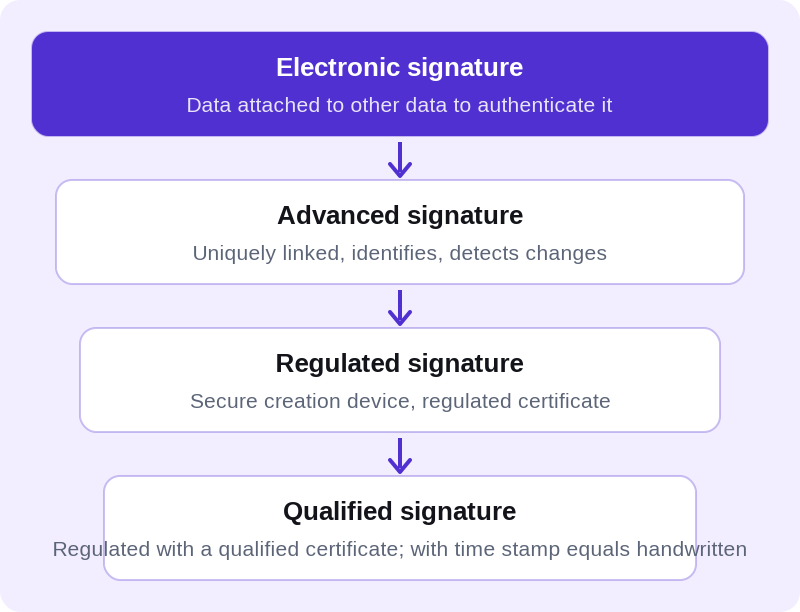
Art. 2 ZertES defines four levels that build on one another. The table puts them next to what each one means for a board document.
| Level | What the law requires | Typical example | For board minutes |
|---|---|---|---|
| Electronic signature | Electronic data attached to or logically linked with other data, used for authentication | A typed name, a scanned signature image, a click on "approve" | Not equivalent to handwriting; legal effect for Art. 713 para. 3 is unclear |
| Advanced electronic signature | Linked exclusively to the holder, identifies the holder, created with means under the holder's sole control, makes later changes detectable | A signature that seals the document so later edits show, linked to an identified signer | Not equivalent to handwriting; legal effect for Art. 713 para. 3 is unclear |
| Regulated electronic signature | Advanced signature made with a secure signature creation device, based on a regulated certificate issued to a natural person | The step on which the qualified level builds | Not equivalent to handwriting |
| Qualified electronic signature | Regulated signature based on a qualified certificate | Signature from a provider recognised in Switzerland, after identity check | With a qualified time stamp: equivalent to handwriting (Art. 14 para. 2bis CO) |
Two details matter in practice. First, the equivalence in Art. 14 para. 2bis CO only applies to a qualified signature combined with a qualified time stamp. Second, a regulated certificate, and therefore also a qualified one, requires the holder to appear in person and prove their identity, unless the Federal Council allows exceptions (Art. 9 para. 1 and 4 ZertES). Each signer therefore has to be identified once before the first signature, which is worth doing well before the minutes are due.
Which board documents need which form?
| Document | Legal requirement | Safe electronic option |
|---|---|---|
| Resolution taken electronically (circular resolution) | No signature, unless the board determined otherwise in writing (Art. 713 para. 2 CO) | Record each vote with name and time; keep the text that was voted on |
| Circular resolution on paper | Written approval of the proposal (Art. 713 para. 2 no. 3 CO) | Switch to electronic form, or have each member sign |
| Board meeting minutes | Signed by the chair and the secretary (Art. 713 para. 3 CO) | Qualified electronic signature with qualified time stamp for both |
| General meeting minutes | Signed by the secretary and the chair of the meeting (Art. 702 para. 3 CO) | Qualified electronic signature with qualified time stamp for both |
| Amendment of articles, capital measures | Notarial deed (Art. 647 CO) | None: the notary's deed is required |
| Organisational regulations, internal instructions | No specific form in the law (Art. 716b CO) | Resolution in the minutes plus a dated, approved version on file |
If your board deals with notarised acts, our overview of notarial deeds for Swiss boards lists which ones need a notary rather than a signature.
Is a simpler e-signature enough for the minutes?
The law does not say. Art. 713 para. 3 CO requires the minutes to be signed but does not state expressly whether that means a signature in the sense of Art. 14 CO. Whether an advanced signature, or an approval click in a workflow tool, satisfies it is a question of interpretation this article does not answer.
In practice the question comes down to risk. Minutes are evidence: of what was decided, of who was present, of what a director said before a decision later turned out badly. A qualified signature removes any argument about the form. A simpler form may be fine for routine meetings, but the board should decide that consciously, with legal advice, and record its rule in the organisational regulations.
Can a director abroad sign with a foreign qualified signature?
Not automatically. A qualified signature under Swiss law is based on a certificate from a provider recognised under ZertES. Foreign providers can be recognised by the Swiss recognition body if their foreign recognition is equivalent and certain cooperation conditions are met (Art. 3 para. 2 ZertES). A qualified signature under the EU eIDAS rules is therefore not by itself a Swiss qualified signature.
For a chair or secretary based in Germany or Austria, the simplest route is a certificate from a provider that is recognised in Switzerland. Check this before the first meeting, not when the minutes are waiting. If your signing service offers several standards, the signer has to choose the Swiss qualified one.
How do chair and secretary sign the minutes, step by step?
| Step | Owner | What to watch |
|---|---|---|
| 1. Circulate the draft for comments | Secretary | Use one channel and one deadline so comments do not arrive in parallel versions |
| 2. Incorporate changes and settle disputed wording with the chair | Secretary, chair | Record a member's request for a different wording if the chair does not accept it |
| 3. Produce the final PDF, ideally PDF/A | Secretary | Nothing changes after this point; the file name carries the meeting date and "final" |
| 4. Secretary signs with a qualified signature and qualified time stamp | Secretary | Check that the service applies the qualified time stamp, not just a server time |
| 5. Chair signs the same file | Chair | Both signatures on one file; never one on paper and one electronically |
| 6. Validate the signatures and file the signed original | Secretary | Keep the validation report with the file |
| 7. Note the approval in the next minutes, if your board approves minutes formally | Secretary | Corrections go into a new entry, not into the signed file |
Whether and how a board approves its minutes is a separate question; see approval of board minutes.
Which mistakes make an e-signed protocol worthless?
- Hybrid signing: the chair signs a printout, the secretary signs the PDF. Now there are two documents and neither carries both signatures.
- Editing after signing: even a corrected typo breaks the signature check. Corrections belong in a new document or the next minutes.
- Using an advanced signature by default because the signing service pre-selects it, without anyone deciding that this level is enough.
- A foreign qualified signature for a Swiss company, without checking whether the provider is recognised in Switzerland.
- Signing a Word file or a document with live fields, so the content shown can differ from what was signed.
- Keeping only the printout. The signed electronic file is the original; a printout is a copy.
What should the organisational regulations say?
Because Art. 713 para. 2 CO lets the board set its own rule for electronic resolutions in writing, the organisational regulations are the right place to settle signatures once. A sample clause, to be checked by your legal adviser:
Agree on where the signed originals are stored, who has access and how long they are kept. Our article on board records retention and deletion covers the archive side.
Where does a board portal fit in?
A board portal and a signing service do different jobs. Konsaro records votes and circular resolutions by name and time, which gives an electronic resolution under Art. 713 para. 2 CO a reliable record. The minutes export as PDF and can then be signed with whichever qualified signing service your company uses. See decisions and voting and minutes and follow-up. How other portals handle qualified signatures is compared in board portals and qualified e-signatures.
Frequently asked questions
Can Swiss board minutes be signed electronically?
Yes. A qualified electronic signature with a qualified time stamp is equivalent to a handwritten signature (Art. 14 para. 2bis CO). Whether simpler electronic forms satisfy Art. 713 para. 3 CO is not expressly regulated.
Who must sign the board minutes?
The chair and the secretary (Art. 713 para. 3 CO). The other members do not sign; their agreement with the content is usually shown by approving the minutes at the next meeting.
Does a circular resolution by e-mail or portal need a signature?
If it is taken in electronic form, no signature is required, unless the board has determined otherwise in writing (Art. 713 para. 2 CO). What matters is a reliable record of the text, the votes and their timing.
Is a signature from DocuSign or Skribble qualified?
It depends on the signature level applied to the document, not on the brand. Check the level shown in the signature details: only the qualified level from a provider recognised in Switzerland, with a qualified time stamp, is equivalent to handwriting under Art. 14 para. 2bis CO.
Can the chair sign on paper and the secretary electronically?
Avoid it. You end up with two documents, each carrying one signature. Both should sign the same original, either on paper or electronically.
Is an EU qualified signature valid in Switzerland?
Not automatically. ZertES requires a provider recognised in Switzerland; foreign providers can be recognised under conditions set in Art. 3 para. 2 ZertES. Check the provider before relying on it.
Does an electronic signature replace notarisation?
No. Where the law requires a notarial deed, for example for amending the articles (Art. 647 CO), a notary is needed.
Sources
- Swiss Code of Obligations (SR 220), Art. 14: signature (checked 29 October 2026)
- Swiss Code of Obligations (SR 220), Art. 647: amendment of the articles (checked 29 October 2026)
- Swiss Code of Obligations (SR 220), Art. 702: minutes of the general meeting (checked 29 October 2026)
- Swiss Code of Obligations (SR 220), Art. 713: board resolutions and minutes (checked 29 October 2026)
- Swiss Code of Obligations (SR 220), Art. 716b: organisational regulations (checked 29 October 2026)
- Federal Act on Electronic Signatures (ZertES, SR 943.03), Art. 2, 3 and 9 (checked 29 October 2026)