

Swiss board minutes template with notes (Art. 713 CO)
—11 min read
Swiss law requires a board of directors to keep minutes of its deliberations and resolutions, signed by the chair and the secretary (Art. 713 para. 3 CO). It prescribes nothing about the layout. A practical template therefore has six parts: a header with attendance, conflicts of interest, agenda items with the discussion, the resolution wording, the vote and the action items, plus the signatures.
What does Swiss law require of board minutes?
Art. 713 para. 3 CO has one sentence on minutes: the deliberations and resolutions are recorded in minutes, signed by the chair and the person taking the minutes. So the law names two contents and two signatures. It says nothing about length, structure or a deadline for finishing them.
Other rules feed into the minutes indirectly. Resolutions pass with the majority of votes cast, and the chair has the casting vote unless the articles provide otherwise (Art. 713 para. 1 CO). Members of the board and of management inform the board immediately and fully about conflicts of interest, and the board takes the measures needed (Art. 717a CO). Both should be readable from the minutes later.
Why minutes matter this much is the subject of our post on minutes as the control point: they are often the only record of what a decision rested on.
How is the template laid out?
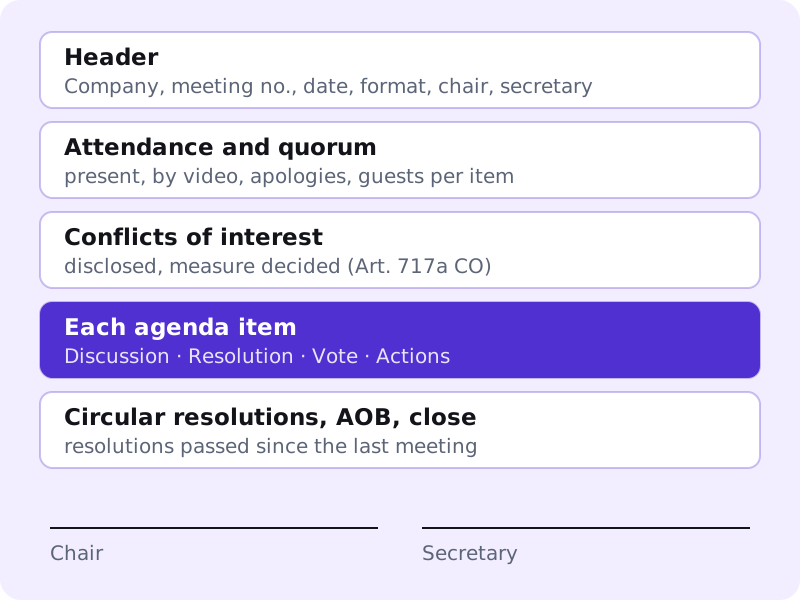
| Part | What goes in | Law or practice |
|---|---|---|
| Header | Company, meeting no., date, time, format (in person, video, hybrid), chair, secretary | Practice |
| Attendance | Present, joined by video, excused, guests with their agenda item | Practice; needed to prove majorities |
| Quorum | Number present and the rule from the articles or organisational regulations | Only if your rules set a quorum |
| Conflicts of interest | Conflicts disclosed and the measure decided, per item | Art. 717a CO |
| Agenda items | Presented by, discussion in a few lines | Art. 713 para. 3 CO (deliberations) |
| Resolution | The wording as resolved | Art. 713 para. 3 CO (resolutions) |
| Vote | Yes, no, abstentions, casting vote, recorded dissent | Art. 713 para. 1 CO; practice |
| Action items | Action, owner, due date | Practice |
| Signatures | Chair and secretary | Art. 713 para. 3 CO |
What belongs in the header?
The header answers two questions: who was there, and could the board decide? Record who attended in person, who joined by video, who sent apologies and which guests attended which item. Listing guests only for their items helps later when someone asks who heard a confidential discussion.
Art. 713 CO sets no attendance quorum for the board. If your articles or organisational regulations do, name the rule in the header and record that it was met. If members arrive late or leave early, note it with the time, because it can change the majority on a single item. Our post on late arrivals and quorum covers the traps.
Right after attendance comes the question about conflicts of interest on the agenda. If the minutes say "none", that is also a statement that counts later.
How do you minute a resolution?
The resolution goes in word for word, as it stood in the proposal or as amended in the meeting. Summarise the discussion in a few lines: the main points, questions and answers. Who said what belongs in the minutes only where it matters, for example a vote against with reasons.
| Situation | Wording in the minutes |
|---|---|
| Resolution | "The Board of Directors approves the 2027 budget as set out in paper 7.1." |
| Vote against with reasons | "[Name] voted against the proposal and asked for the following reasons to be minuted: […]" |
| Abstention | "[Name] abstained." |
| Recusal | "[Name] disclosed a conflict of interest on item [no.]. The board decided that [name] would not take part in the vote. [Name] left the meeting at [time]." |
| Casting vote | "With [ ] votes for and [ ] against, the chair decided with the casting vote." |
| Circular resolution | "By circular resolution of [date], the board resolved: […]. Votes: [ ] yes, [ ] no, [ ] abstentions." |
| Noting a report | "The board takes note of report [no.]." |
Under each resolution, list the action items that follow from it: what, who, by when. Each action then traces back to an agenda item, and the action list for the next meeting builds directly on the minutes.
What does a filled-in entry look like?
Every agenda item gets the same four lines: discussion, resolution, vote, actions. The example below shows item 7.1 for the fictional Muster AG. All names and amounts in it are invented.
| Line | Entry |
|---|---|
| Item | 7.1 Budget 2027. Presented by the CFO, paper 7.1, version of 3 November 2026. |
| Discussion | The CFO explained the two main changes against 2026: a new sales position and higher licence costs. The board asked for the effect on liquidity in the second half-year. The CFO answered that it stays within the credit line. The chair asked for a quarterly forecast. |
| Resolution | The Board of Directors approves the 2027 budget as set out in paper 7.1, with a total expenditure of CHF 4,200,000. |
| Vote | Five in favour, none against, one abstention (M. Keller). Carried. |
| Actions | CFO: quarterly liquidity forecast to the board, from the first quarter of 2027. Board office: file paper 7.1, version of 3 November 2026, with the minutes. |
Three details do the work. The paper and its version date are named, so nobody has to ask which budget was approved. The resolution can be read without the meeting. The abstention is attributed, because a vote count alone cannot answer a later question about who voted how.
Who does what before, during and after the meeting?
A template is only half of it; the other half is a routine with owners. The steps below fit a board with a board secretary and a chair. Smaller boards combine the roles.
| When | Who | What |
|---|---|---|
| Before | Board secretary | Create the minutes from the agenda: one section per item number, header and attendance list filled in, resolution wording from the papers pasted in as the starting point. |
| During | Minute-taker | Note arrival and departure times, the final wording of each resolution, the votes and any recusal. Ask the chair to read the wording back before moving on. |
| Same or next day | Board secretary | Send the action items to their owners. Do not wait for the minutes to be approved. |
| Within the period your rules set | Board secretary, chair | Complete the draft. The chair checks resolutions, votes and tone first. |
| After the chair's review | Board secretary | Send the draft to all directors, marked as a draft, with a date for comments. |
| Next meeting | Board, chair, minute-taker | Approve the minutes, record corrections, sign, file, update the decisions register. |
A short covering note keeps the circulation clean. Sample wording: "Dear all, attached are the draft minutes of the board meeting of 3 November 2026. Please send corrections to resolutions, votes and actions by 14 November. Corrections to the discussion summary can wait for the meeting. The minutes are not final until the board approves them." The dates are examples; use the timetable your regulations set.
Which mistakes make minutes hard to defend later?
- Resolutions written as discussion: "The board felt the budget was reasonable." Fix: write the decision as a sentence that starts with the body and a verb, and keep the feeling out of it.
- No paper reference. Fix: name the paper and its version date in every resolution that rests on one.
- Votes missing. Fix: record the count, or "unanimous", for every resolution, and abstentions and votes against by name.
- Conflicts of interest not mentioned. Fix: keep a standing line after attendance, even when the answer is "none".
- Late arrivals not timed. Fix: write the time next to the name and mark the agenda item from which the member took part.
- Actions without an owner or date. Fix: three fields, every time: what, who, by when.
- Minutes that exist only as an editable document in a mailbox. Fix: one final PDF, signed, filed where the board office keeps its records, and the draft marked as such until then.
The most common source of trouble is the second one. A budget approved "as presented" is a problem a year later if three versions of the budget circulated. Our post on the minutes as a control point shows how that plays out, and how detailed the minutes should be covers the level of detail.
What changes with your articles and organisational regulations?
The statute gives you the minimum. Your articles and organisational regulations can add to it, and a good template has a slot for each of these points:
- Quorum and majorities, if they differ from the default rule. Name them in the header.
- Who approves the minutes, and when: the full board at its next meeting, or the chair alone.
- A deadline for the draft, if you want one.
- The language of the minutes, and which version prevails if there are two. See our template for English-language board minutes.
- Who may read the minutes, including parts of a session held without management.
- How long minutes, recordings and transcripts are kept, and who deletes them.
- The form of the signature. Our post on the electronic signature for board minutes goes through the options (German-language post).
A GmbH, a foundation board or an association committee works on different foundations: the law that applies to them, the foundation deed or the articles. The sections above carry over as a checklist, not as legal rules. We have separate templates for the foundation board and the association committee.
Who signs, and is an electronic signature enough?
The chair and the secretary sign (Art. 713 para. 3 CO). Many boards first approve the minutes at the next meeting and sign afterwards. That is practice, not law.
A qualified electronic signature with a qualified time stamp is equal to a handwritten one (Art. 14 para. 2bis CO). Whether a simpler electronic form is enough for board minutes, the law does not say explicitly. That question is open. Settle it with your lawyer and record what your board chose.
How long should you keep the minutes?
Art. 958f CO requires ten years for the accounting records, vouchers, annual report and audit report. Board minutes are not named. Many companies still keep them at least as long, because they document decisions that the books and reports rest on. Set the rule for minutes, recordings and transcripts in the organisational regulations or a directive.
How does a board portal help with minutes?
In Konsaro, the minutes record attendance (present, excused, absent or remote) and decisions and tasks per agenda item, with a version history and PDF export. The Minutes Copilot turns the meeting transcript into a first draft that the board office reviews. See minutes and follow-up and the page for the corporate secretary.
Frequently asked questions
Do Swiss board minutes have to be verbatim?
No. Art. 713 para. 3 CO asks for minutes of deliberations and resolutions, not a transcript. The usual form is resolution minutes with a short summary of the discussion; resolutions are recorded word for word.
Who has to sign the board minutes?
The chair and the person taking the minutes (Art. 713 para. 3 CO). Approval by the full board at the next meeting is common practice but not required by law.
Should abstentions be recorded by name?
The law does not require it. Many boards record abstentions and votes against by name, because how a member voted can matter in a later liability question. Reasons are usually minuted only if the member asks.
How are circular resolutions recorded?
A circular resolution is only possible if no member asks for an oral discussion (Art. 713 para. 2 no. 3 CO). It is usually recorded as a separate item at the next meeting that lists each circular resolution with its date, wording and votes. The circular resolution documents are attached to the minutes.
May management read the board minutes?
Your organisational regulations or the board itself decide. Parts of a session without management are often minuted separately and shared with the board only.
How soon after the meeting should the minutes be ready?
Art. 713 CO sets no deadline. Your organisational regulations may. In practice the action items go out within a day, and the draft goes to the chair and then to the board early enough that directors still remember the meeting.
What if a director disagrees with the minutes?
Raise it before approval. The usual way is to correct the minutes at the meeting that approves them and to record the correction. If the director believes a resolution was recorded wrongly, say so in the approval item and minute that too.
Is a decisions register enough instead of minutes?
No. A register summarises decisions in one list and helps you find them. The law asks for minutes of deliberations and resolutions. Keep both and link the register entries to the minutes; see decisions register versus minutes.
Sources
- Swiss Code of Obligations (SR 220), Art. 713: board resolutions and minutes (checked 29 October 2026)
- Swiss Code of Obligations (SR 220), Art. 717a: conflicts of interest (checked 29 October 2026)
- Swiss Code of Obligations (SR 220), Art. 14 para. 2bis: qualified electronic signature (checked 29 October 2026)
- Swiss Code of Obligations (SR 220), Art. 958f: retention (checked 29 October 2026)