

Foundation Board Minutes Template (Switzerland) with Example
—10 min read

Swiss civil law does not prescribe a specific form of minutes for a foundation board; the deed of foundation sets out the bodies and how the foundation is managed (Art. 83 CC). Good minutes still record the same core as for a company: attendance and quorum, conflicts of interest, resolutions word for word with votes, and actions. A foundation adds one thing: for each grant or investment decision, how it serves the foundation's purpose.
What does the law say about the foundation board?
Little, and mostly indirectly. The bodies of the foundation and how it is managed are set by the deed of foundation (Art. 83 CC). The supreme body keeps the accounts (Art. 83a CC) and appoints an auditor unless the supervisory authority exempts the foundation (Art. 83b CC). The foundation is supervised by the public authority it belongs to, which ensures that its assets are used for their purpose (Art. 84 CC).
That sets the standard for the minutes: they must show that the board used the assets for the purpose and carried out its duties under the deed and regulations. Ask your supervisory authority which documents it requests each year; practice is not the same everywhere.
How is the template structured?
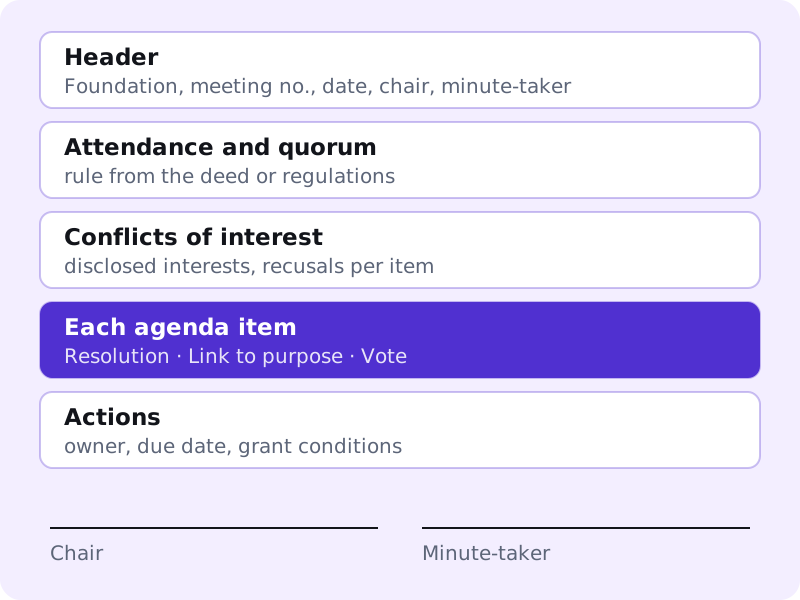
| Part | Content | Note |
|---|---|---|
| Header | Foundation, meeting no., date, place or video, chair, minute-taker | Chair as per deed or regulations |
| Attendance | Present, remote, apologies, guests per item | Mark the managing director as a guest |
| Quorum | Number present and the rule from the deed or regulations | The rule is there, not in the law |
| Conflicts of interest | Interests disclosed and measure per item | Especially for grants to related organisations |
| Agenda items | Short discussion, resolution word for word | Per grant: recipient, amount, link to purpose |
| Vote | Yes, no, abstentions, recusals | Majority as per deed or regulations |
| Actions | Action, owner, due date | Also track conditions attached to grants |
| Signatures | As per deed or regulations, usually chair and minute-taker | Set the rule in your regulations |
Full, resolution or narrative minutes: which fits a foundation?
For most foundation boards, resolution minutes with a short reason are enough: they record what was decided and why, without every remark. The Civil Code prescribes none of the forms; the deed or the regulations can, so look there first (Art. 83 CC).
| Form | Content | Fits |
|---|---|---|
| Resolution minutes | Motions, resolutions word for word, votes, actions | The default for volunteer boards with a clear agenda |
| Resolution minutes with reasons | As above, plus the deciding reasons in two or three sentences | Grants, investment decisions, deviations from the regulations: recommended |
| Narrative minutes | Summary of the discussion, with positions of individual members | Contested or liability-sensitive matters where the route to the decision matters |
| Verbatim minutes | Word-for-word transcript | Rarely needed; only if the deed, regulations or a special occasion require it |
The reason for the reasons is supervision: the authority ensures that the assets are used for the foundation's purpose (Art. 84 para. 2 CC). A resolution without a reason forces questions that one sentence in the minutes would have saved.
How do you minute grant and investment decisions?
For a grant-making foundation, grants are the core business. For each application, record the applicant, the amount requested and approved, the link to the purpose, any conditions, and whether a member recused. For investment decisions: the investment regulations, any deviation and who proposed it.
| Situation | Wording |
|---|---|
| Grant | "The board approves a grant of CHF [amount] to [organisation] for [project]. The project serves the purpose set out in Art. [ ] of the deed because [reason]. Condition: final report by [date]." |
| Rejection | "The board rejects the application from [organisation] because [reason, e.g. outside the purpose]." |
| Recusal | "[Name] disclosed a link to [organisation] and recused from item [no.]." |
| Investment | "The board approves the [year] investment strategy as set out in paper [no.] within the investment regulations." |
Why exact wording matters is covered in our post on minutes as the control point.
What does a completed set of minutes look like? Example of the Muster Foundation
The following example is invented: the "Muster Foundation" and every name and amount in it do not exist. It shows how short useful minutes can be.
| Part | Entry |
|---|---|
| Header | Muster Foundation, board meeting no. 3/2027, 12 May 2027, 14:00–16:15, meeting room of the office. Chair: president. Minutes: secretary. |
| Attendance | Present: five of five members, one by video. Guest for item 3: managing director. |
| Quorum | "The chair notes that the board has a quorum under Art. [ ] of the organisational regulations." |
| Interests | Item 3: One member discloses that they sit on the committee of the applicant and recuses. |
| Item 3: application of Verein Beispiel | Application for CHF 40,000 for a reading-promotion project. Discussion in keywords: link to purpose is clear, applicant's own funds secured, duration two years. |
| Resolution | "The board approves a grant of CHF 30,000 to Verein Beispiel for the reading-promotion project. The project serves the purpose in Art. 2 of the deed because it reaches children from low-income families. Condition: interim report by 30 June 2028, final report by 31 January 2029." Yes 3, no 0, abstention 1, recused 1. |
| Actions | Send approval letter with conditions · managing director · 19.05.2027. Enter reporting dates in the action list · secretary · 19.05.2027. |
| Signatures | Date, signature of chair and minute-taker, as far as the deed or regulations require. |
Two details carry the minutes: the approved amount differs from the requested one and the reason is stated, and the recusal is counted in the vote so that the figures add up.
How do you handle conflicts of interest and recusal?
Disclose interests at the start of the meeting and record for each item who recused and for which part. When a member must recuse is governed first by the deed and the organisational regulations; if they are silent, add a rule and clear doubtful cases with the supervisory authority or a specialist.
- Disclosure: A list of members' mandates and links goes with the agenda, or is asked for at the start.
- Recusal: The member leaves the deliberation and the vote. The minutes record when they left and when they came back.
- Quorum: After the recusal, check that enough members remain to decide. The rule is in the deed or regulations.
- Remuneration: The total remuneration paid to the board and management must be disclosed separately to the supervisory authority every year (Art. 84b CC). Decide fees in the minutes, with the amount and the recusal of those affected.
Who does what before and after the meeting?
| Step | Who | When |
|---|---|---|
| Send agenda and papers | Secretariat, after the chair's release | Deadline per regulations |
| Ask for interests and check quorum | Chair | Start of the meeting |
| Prepare resolution wording | Managing director, per application for grants | With the papers |
| Read the resolution aloud | Chair | Per item, before the vote |
| Send the draft minutes | Minute-taker | Promptly; set the deadline in the regulations |
| Approve and sign | Board, chair and minute-taker | At the next meeting or by circular resolution |
| Follow up actions | Managing director | Until the next meeting |
How a draft gets approved is covered in our post on approving board minutes; for the body itself read Stiftungsrat: Pflichten, Sitzungen und Protokoll.
What changes by type of foundation?
| Type | Feature | Effect on the minutes |
|---|---|---|
| Charitable grant-making foundation | Under supervision (Art. 84 CC) | Link to purpose and reasons per grant; write minutes an outsider can follow |
| Family foundation | No supervision and no auditor required (Art. 87 CC) | No outside reader, but beneficiaries and heirs: record distributions and interests carefully |
| Church foundation | Also not under the supervisory authority, subject to public law (Art. 87 CC) | Check church or cantonal requirements; the deed and regulations remain the standard |
| Occupational pension foundation | Additional pension law (e.g. Art. 51a BVG) and its own supervision (Art. 61 BVG) | Own duties for regulations and investments; this template does not cover them |
Requirements for pension foundations are in our post on software for the board of a pension fund.
Where do foundation minutes usually fail?
Beneficiaries, creditors, the founder, later donors (Zustifter) and former or current board members who have an interest in lawful management can complain to the supervisory authority about acts and omissions of the foundation's bodies (Art. 84 para. 3 CC). In such a procedure the question is what the board decided, when and why, and that is where weak minutes show.
- Grants without a link to the purpose: "application approved" is not enough.
- Recusal not recorded: it stays unclear who took part in the vote.
- Discussion without a resolution: the minutes describe the debate but name no decision, figure or condition.
- Circular resolutions missing from the minutes: they belong in the minutes of the next meeting.
- Conditions without follow-up: the reporting duty is in the resolution but on no action list.
- Signature missing or not as the deed and regulations require.
Circular resolutions are the subject of circular resolutions and online meetings in the foundation board.
What applies in financial difficulty?
If insolvency or over-indebtedness threatens, the supreme body must notify the supervisory authority immediately (Art. 84a para. 1 CC). Record in the minutes when the board recognised the situation, which measures it decided and when it informed the authority. This part of the minutes can matter a great deal later.
How does a board portal help a foundation board?
Many foundation boards are volunteers who meet rarely, so it matters that papers, resolutions and actions sit in one place. In Konsaro, the minutes record attendance and decisions and tasks per agenda item and export as PDF; circular resolutions between meetings run digitally. See minutes and follow-up and decisions and voting.
Frequently asked questions
Does Swiss law require minutes for a foundation board?
The Civil Code does not regulate foundation board minutes explicitly. The deed sets out the bodies and management (Art. 83 CC), and many deeds and regulations require minutes.
Who signs foundation board minutes?
Whoever the deed or regulations name, usually the chair and the minute-taker. If there is no rule, set one in the foundation's regulations.
Will the supervisory authority read the minutes?
That depends on the authority and the occasion. Ask yours which documents it requests each year, and keep minutes an outsider can follow.
Can a foundation board decide by circular resolution?
If the deed or regulations allow it. Set form, deadline and majority there explicitly.
Should the managing director appear in the minutes?
As a guest, with the items they attend. The board makes the decisions, and the minutes should show that clearly.
How long must a foundation keep its minutes?
The Civil Code sets no separate period for minutes. The supreme body keeps the books under the Code of Obligations rules, applied accordingly (Art. 83a CC); set retention in the regulations and ask your authority if in doubt.
Are resolution minutes enough, or do we need narrative minutes?
Resolution minutes with a short reason are enough in the normal case. Narrative minutes pay off for contested or liability-sensitive matters, where the route to the decision may have to be explained later.
Must a member recuse when a related organisation applies?
The deed and regulations decide. The usual practice is to disclose the interest, leave the deliberation and vote, and record both in the minutes.
Does the template work for a family foundation?
As a frame, yes. A family foundation is not under state supervision (Art. 87 CC), but the minutes remain the evidence towards beneficiaries and for later questions.
How soon should the minutes go out?
There is no statutory deadline. Set one in the regulations and send the draft while the meeting is fresh.
Sources
- Swiss Civil Code (SR 210), Art. 83, 83a, 83b: bodies, accounts, auditor (checked 29 October 2026)
- Swiss Civil Code (SR 210), Art. 84 and 84a: supervision, over-indebtedness (checked 29 October 2026)
- Swiss Civil Code (SR 210), Art. 84a: threatened insolvency or over-indebtedness (checked 29 October 2026)
- Swiss Civil Code (SR 210), Art. 84b: remuneration disclosure to the supervisory authority (checked 29 October 2026)
- Swiss Civil Code (SR 210), Art. 87: family and church foundations (checked 29 October 2026)
- Federal Act on Occupational Pensions (BVG, SR 831.40), Art. 51a and 61: supreme body, supervision (checked 29 October 2026)